
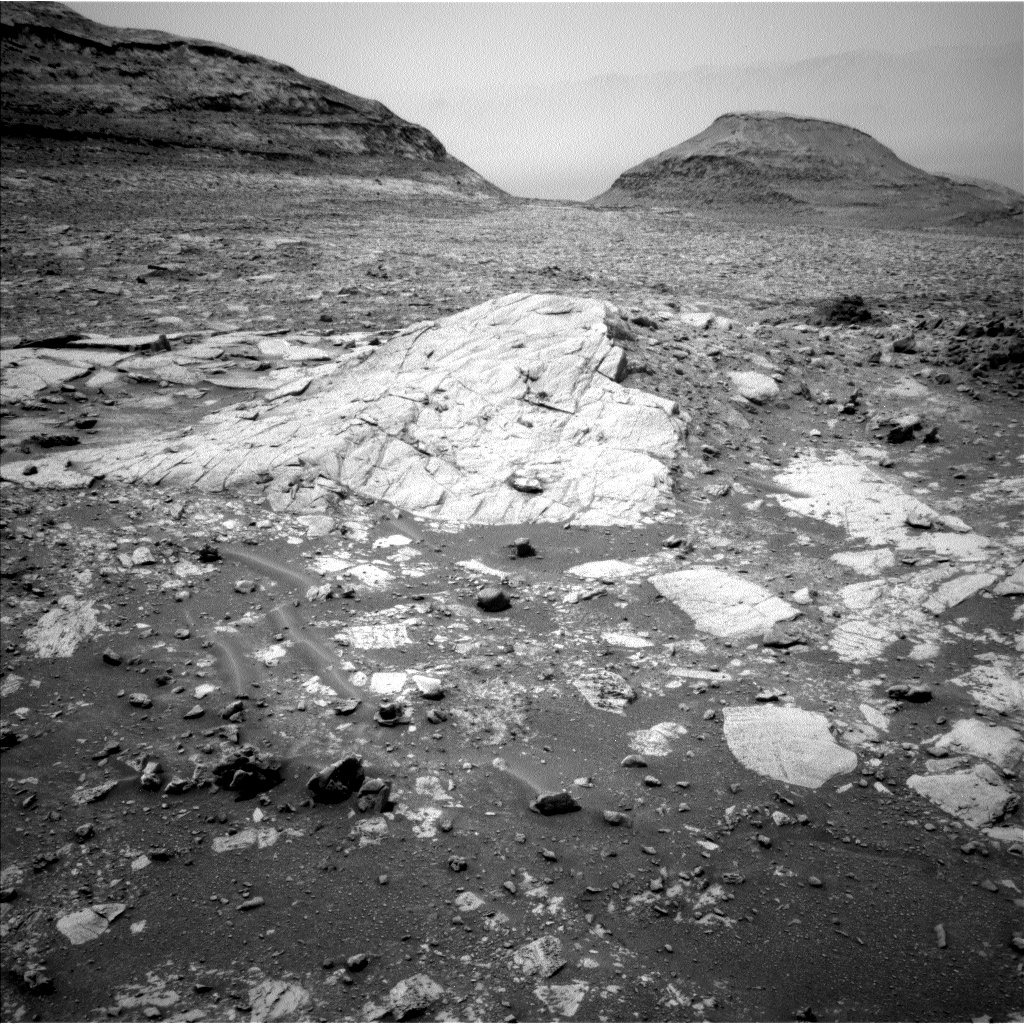
This photo taken by NASA’s Mars rover Curiosity of ‘Balloon Dome’ covers a low dome-like structure formed by the light-toned slab-like rocks. This image was taken by Left Navigation Camera aboard Curiosity on Sol 4301 — Martian day 4,301 of the Mars Science Laboratory mission — on Sept. 11, 2024, at 09:14:42 UTC.
NASA/JPL-Caltech
The rover is enroute from the Tungsten Hills site to the next priority site for Gediz Vallis channel exploration. Our goal is to approach closely enough to conduct arm science on one of the many large dark-toned “float” blocks in the channel, as well as on one of the light-toned slabs. We have observed dark blocks within the channel that appear to be related to the Stimson formation material previously encountered by the rover. However, some blocks may be of a different nature. We believe these blocks did not originate within the channel, implying they must have come from a higher elevation not yet explored by the rover. Understanding the mechanism of their transport into the channel is of particular interest to us.
We have not reached our destination yet, but the 4302-4303 plan includes significant long-range characterization of dark-toned and light-toned materials through imaging. The Mastcam mosaics, “Bakeoven Meadow” and “Balloon Dome,” will provide context for future detailed studies of the dark-toned blocks. The extensive “Balloon Dome” mosaic also encompasses a low, dome-like formation composed of light-toned, slab-like rocks. Additionally, smaller mosaics will focus on a set of targets featuring juxtapositions of different types of light-toned and dark-toned materials within the same block, specifically “Rattlesnake Creek,” which seems to be in situ, and “Casa Diablo Hot Springs,” which is a displaced piece.
The workspace of the rover’s arm has opened a window into contemporary aeolian science with the sandy ripple known as Sandy Meadow serving as the subject. The shape of this ripple will be captured through Mastcam stereo imaging, and the grain size within it will be revealed by high-resolution MAHLI images. Additionally, the current state of the environment will be tracked through a suprahorizon observation, a survey for dust devils, and the monitoring of the rover’s deck for any signs of dust displacement.
The workspace contained small samples of the dark float blocks, and the composition of one sample will be analyzed by both APXS and ChemCam LIBS, targeting “Lucy’s Foot Pass” and “Colt Lake” respectively.
The Mastcam Boneyard Meadow mosaic offers a retrospective analysis of the dark rippled block at Tungsten Hills, examining its bedding plane to discern the genesis of the ripples and the respective contributions of water and wind to their formation.
The rover’s communication in this terrain continues to pose challenges. In a strategic move, the drive originally scheduled for the second sol was advanced to the first sol. This adjustment aims to enhance the downlink data volume for post-drive imaging, facilitating improved planning for the anticipated science waypoint in the weekend’s itinerary. Nevertheless, the imperative to maintain communications dictates that the rover conclude its drive within a limited range of orientations. This constraint may complicate the approach to the forthcoming science target. The results of this maneuver will become clear on Friday.

Comments are closed.