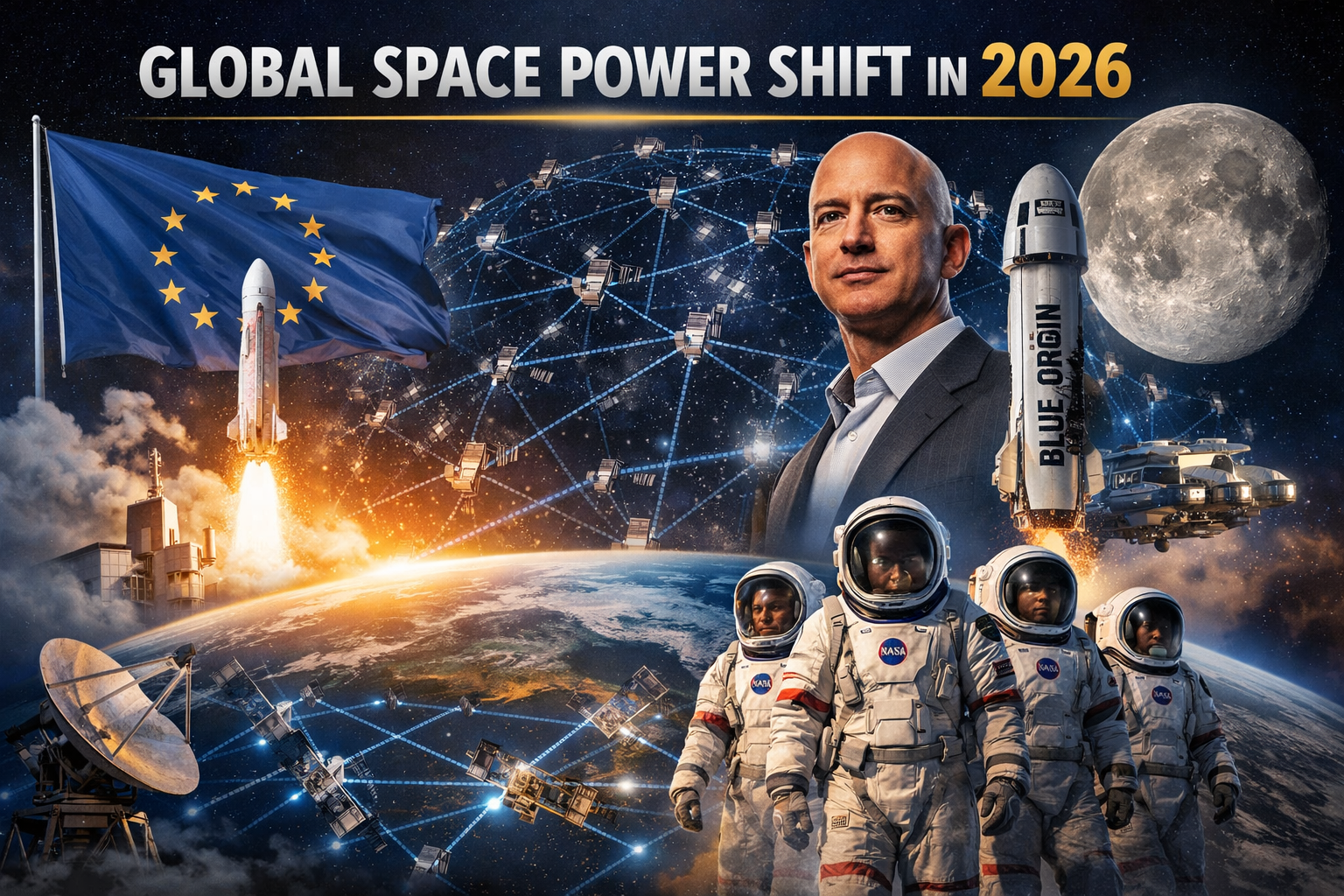
The global space sector is rapidly evolving in early 2026, and recent developments show a clear shift toward strategic autonomy, commercial scale-up, and next-generation infrastructure in orbit. From European policy shifts to ambitious commercial constellations and ongoing Moon mission preparations, the space landscape is entering a decisive phase in the new space age.
1. Europe Moves Toward Space Strategic Independence
France’s Minister for Space, Philippe Baptiste, has issued a strong directive for the European Union: prioritize European made space and defense components and end reliance on non-EU technology, particularly from the United States. His call highlights growing concerns over supply chain vulnerabilities and operational autonomy — especially after disruptions involving U.S. satellite connectivity during geopolitical crises.
Baptiste’s proposal includes:
- A “Buy European Act” for defense and space hardware.
- Development of ITAR-free satellite constellations to avoid export control limitations.
- Shared EU infrastructure planning to replace fragmented national efforts.
This marks an important policy pivot: no longer just collaborating with global partners, but building sovereign European space capabilities.
2. Blue Origin’s TeraWave: A New Competitor on the Satellite Stage
In commercial space news, Jeff Bezos’ Blue Origin announced plans for an ambitious new satellite constellation — TeraWave — set to deploy 5,408 satellites starting in late 2027. Designed to serve enterprise customers, governments, and data centers, TeraWave focuses on ultra-high-speed optical communication — up to 6 Tbps — and positions Blue Origin as a direct competitor to SpaceX’s Starlink ecosystem.
Key differentiators for TeraWave include:
- No consumer-level internet service — focusing purely on corporate and government use.
- Near-space data backbone architecture optimized for AI and cloud infrastructure.
- Deployment via Blue Origin’s reusable New Glenn rocket.
This reflects a broader industry pivot away from consumer broadband toward industrial space networking and edge data services.
3. NASA’s Artemis II: A Historic Lunar Flyby Nears Launch
NASA’s Artemis II mission — the first crewed lunar flight in over half a century — is gearing up for liftoff with a targeted early February launch. The mission will carry four astronauts on a 10-day lunar flyby trajectory, marking a pivotal milestone in the agency’s long-term Moon and Mars exploration strategy.
What makes Artemis II significant:
- First crewed Orion flight around the Moon since Apollo.
- A key milestone in NASA’s broader Artemis program architecture.
- A testbed for deep-space human operations needed for Mars missions.
As the space pioneer returns to crewed lunar exploration, international and commercial partners are watching closely for implications on future collaborative missions.
4. Small Launchers and Commercial Missions Expand Satellite Access
Meanwhile, Rocket Lab successfully completed its first launch of 2026, placing two telecommunications satellites into low Earth orbit for European operator Open Cosmos.
This launch underscores:
- The rising cadence of small launch vehicles in global space access.
- Growing demand for telecom and Earth observation constellations.
- Opportunities for smaller nations and companies to deploy space assets with lower cost barriers.
Why These Trends Matter for SpaceNerve.com Readers
These developments highlight two overarching forces shaping today’s space economy and exploration ecosystem:
- Geopolitical Realignment in Space Policy
Europe’s strategic push for autonomy signals a shift toward regional space ecosystems that can operate independently from traditional superpower dependencies. - Commercialization and Infrastructure Scale-Up
Initiatives like TeraWave and recurring private launch missions reflect the commercialization of deep space infrastructure and the rising value of orbital data networks.
Conclusion: A New Space Epoch
At this early stage of 2026, space exploration and commercialization are stepping into a new era of diversity, autonomy, and scale. From strategic policy reshuffling in Europe to commercial megaconstellations and crewed lunar missions, the space sector is no longer dominated by a single narrative — it is a multifaceted frontier driven by national interests, private innovation, and collective human aspiration.
For SpaceNerve.com, these stories are critical not just for enthusiasts but for anyone tracking space policy, commercial space markets, and frontier exploration trends.
