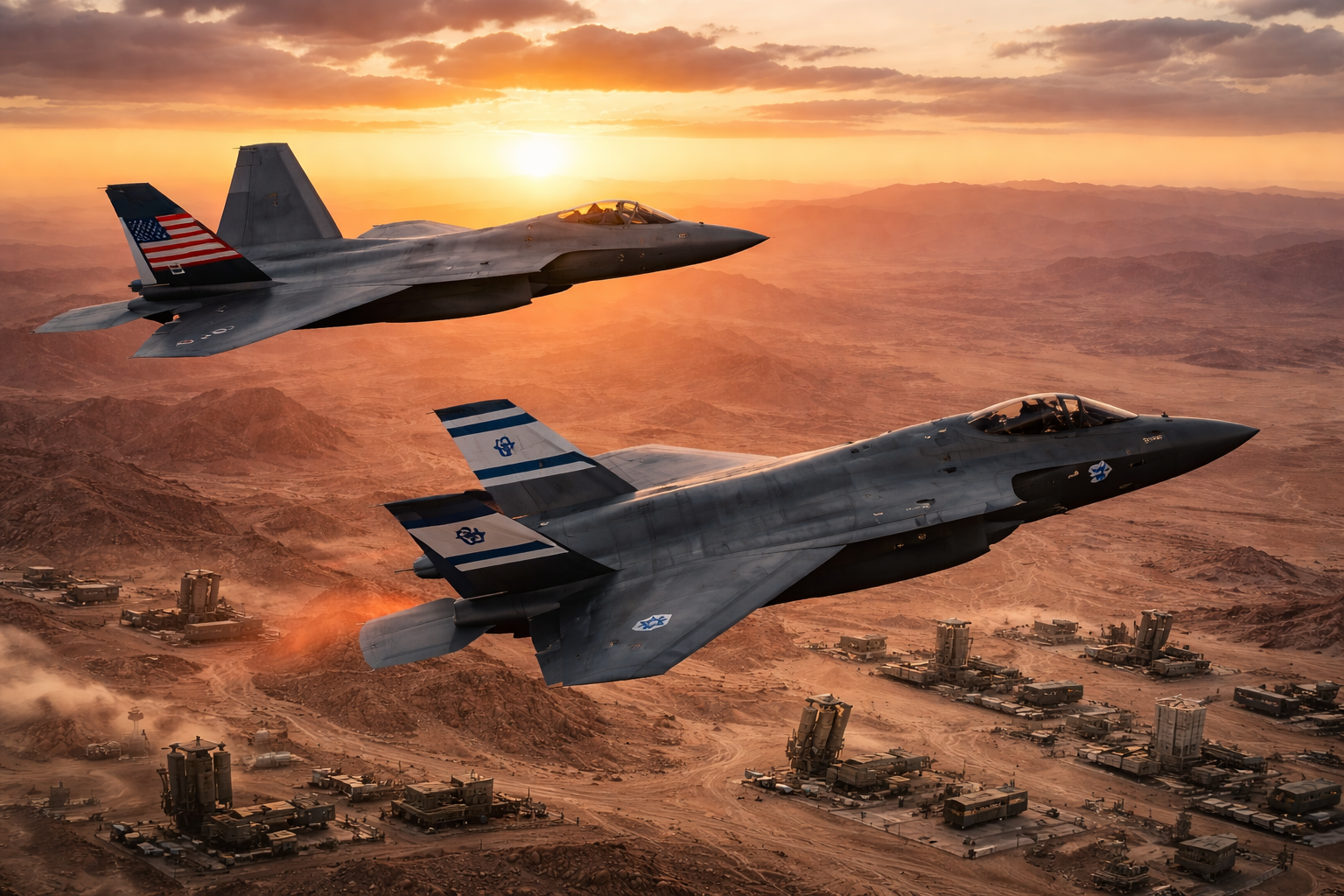
The convergence of fifth-generation stealth aircraft, space-based surveillance systems, and multi-domain command-and-control networks has fundamentally transformed modern warfare. This transformation was laid bare during Operation Epic Fury, the joint U.S.-Israeli military campaign against Iran that commenced on February 28, 2026. The operation represented the most significant demonstration of combined aerospace power since Operation Desert Storm, showcasing how advanced aviation assets and space-based sensors can systematically dismantle a nation’s integrated air defense network in a matter of days.
The Strategic Context: Why Aerospace Capabilities Matter
The strategic landscape preceding Operation Epic Fury was shaped by Iran’s advancing nuclear program and the limitations placed on U.S. military basing options. Saudi Arabia and the United Arab Emirates announced they would not permit U.S. use of their airspace or territory for an attack on Iran, significantly constraining American operational flexibility. This geopolitical reality forced a fundamental rethinking of how to project overwhelming air power into Iranian airspace.
The response was unprecedented: for the first time in history, the United States deployed combat aircraft—specifically F-22 Raptors—to Israeli territory for potential wartime missions against Iran. Approximately 11 F-22s arrived at Ovda air base in southern Israel, marking a historic shift in U.S.-Israeli military cooperation. This deployment, combined with the pre-positioning of additional F-35s and F-15Es at RAF Lakenheath in England, created a multi-axis strike capability that would prove decisive.
The Stealth Triad: B-2, F-22, and F-35 in Concert
At the heart of Operation Epic Fury’s aerospace strategy was what defense analysts have termed the “stealth triad”—the coordinated employment of three distinct low-observable platforms, each fulfilling a specialized role in the strike package.
The B-2 Spirit: Strategic Deep Strike
The Northrop Grumman B-2 Spirit served as the heavy hitter of the stealth fleet. As the only operational aircraft capable of delivering the 30,000-pound GBU-57 Massive Ordnance Penetrator bunker-buster bomb, the B-2 was essential for destroying Iran’s deeply buried nuclear and missile facilities. At least four B-2s conducted round-trip flights directly from the continental United States to strike Iranian missile facilities, each carrying 2,000-pound precision-guided bombs capable of destroying hardened targets from high altitude while maintaining radar evasion.
The B-2’s strategic role extended beyond simple payload delivery. Operating primarily at night and escorted by F-22s, these bombers systematically destroyed underground “missile cities”—subterranean complexes that Iran had constructed to protect its ballistic missile arsenal. The combination of stealth characteristics and massive penetrating payload made the B-2 the only platform capable of neutralizing Iran’s most deeply buried and heavily fortified targets.
The F-22 Raptor: Air Superiority and Escort
Flying at speeds exceeding Mach 2, the F-22 Raptor was explicitly designed to eliminate airborne threats before they could engage friendly bombers. The Raptor’s deployment to Israel represented the first time F-22s had been stationed in Israel for possible combat operations in the Middle East, though they had previously escorted B-2s during Operation Midnight Hammer strikes on Iranian nuclear facilities in June 2025.
The F-22’s role in Epic Fury was multi-faceted. It provided top cover for the slower, more vulnerable B-2 bombers transiting through contested airspace. It also conducted its own precision strikes against high-value air defense nodes. Perhaps most importantly, the F-22’s advanced sensors and stealth characteristics allowed it to operate with near-impunity deep inside Iranian territory, providing real-time threat data to the entire strike package.
The F-35 Lightning II: Sensor Fusion and Tactical Hub
The F-35 Lightning II acted as the intelligence and tactical hub of the strike package. Its advanced sensors—including the AN/APG-81 active electronically scanned array (AESA) radar—identified surface-to-air missile sites, allowing it to execute precision strikes on Iranian radar installations and share targeting data with other platforms. The F-35’s sensor fusion capabilities were described as the “nerve center” of the operation.
The scale of F-35 deployment was substantial. Approximately 30 F-35 Lightning II multirole stealth fighters were deployed from the 48th Fighter Squadron at RAF Lakenheath and the 158th Fighter Squadron from Vermont. Additionally, the Marine Corps contributed a squadron of F-35C aircraft operating from the USS Abraham Lincoln aircraft carrier in the southern region of Iran.
All three stealth platforms utilized specialized coatings and internal weapons bays to minimize their radar cross-section, enabling them to slip past Iran’s indigenous Bavar-373 defense networks undetected. The F-22 and F-35 continuously shared real-time battlefield data through encrypted communication links, creating a highly coordinated strike network across the Persian Gulf.
Israel’s F-35I Adir: Custom-Engineered for Deep Strike
While the U.S. contribution to Epic Fury was overwhelming, Israel’s unique aerospace capabilities proved equally decisive. Israel operates approximately 75 F-35I “Adir” stealth fighters, which are specifically modified with Israeli avionics and weapons systems. More significantly, Israel is the only country authorized by the United States to modify the F-35’s internal hardware and software, a privilege that has yielded dramatic operational advantages.
The most critical Israeli modification was the development of conformal fuel tanks that maintain the aircraft’s low-observable characteristics while significantly extending its range. A standard F-35A has a combat radius of approximately 1,000 kilometers, insufficient to cover Iran’s full territory without aerial refueling. With the new stealth fuel tanks, the F-35I’s expected range far exceeds this baseline, allowing it to reach strategic hotspots deep within Iran without relying on vulnerable aerial refueling tankers. This upgrade package also enables the F-35I to carry four additional missiles on underwing pylons.
The operational impact was profound. Israeli F-35Is penetrated hundreds of kilometers into Iranian territory, delivering precision munitions on critical infrastructure while remaining invisible to Iranian air defenses. Iranian S-300 and S-400 systems never achieved a weapons-grade lock on the Israeli aircraft. The F-35I’s combination of indigenous electronic warfare suites and advanced sensor fusion rendered Iran’s entire integrated air-defense network obsolete.
The Role of Space: Satellites as Force Multipliers
Operation Epic Fury demonstrated that modern aerospace power extends far beyond the atmosphere. Space-based assets provided critical targeting data, early warning of Iranian missile launches, and post-strike damage assessment that enabled rapid re-targeting cycles.
The U.S. Space Force’s Space-Based Infrared System (SBIRS) satellites detected the immense heat plumes of Iranian missile launches instantly, warning coalition forces within seconds to activate defenses. This billion-dollar satellite constellation served as the crown jewel of missile defense, spotting threats from high above Earth.
High-resolution optical satellites like the KH-11 series captured images with a resolution of less than 10 centimeters, allowing intelligence analysts to identify specific vehicle types and weapon systems inside Iranian bases. Synthetic Aperture Radar (SAR) satellites such as “Topaz” provided all-weather, day-night surveillance capabilities, tracking moving targets through clouds, smoke, and total darkness.
Electronic intelligence (ELINT) satellites intercepted signals emitted by Iranian air defense radars, enabling U.S. and Israeli pilots to know exactly where active surface-to-air missile sites were located before entering their engagement envelopes. Massive Signals Intelligence (SIGINT) satellites intercepted encrypted Iranian communications, providing coalition commanders with insight into Tehran’s military intent and command structure.
Space Command (SPACECOM) and Cyber Command (CYBERCOM) also employed non-kinetic measures to disrupt Iran’s sensor and satellite networks, further degrading its ability to mount a coordinated defense.
Multi-Layered Air Defense: Protecting the Homeland
While offensive aerospace capabilities seized headlines, the defensive dimension of Epic Fury was equally critical. Iran retaliated with hundreds of ballistic missiles and drones targeting Israel and U.S. military facilities across the Middle East. The coalition’s ability to intercept these threats relied on a sophisticated, multi-layered air defense architecture.
Israel’s multi-tiered defense system consists of the Arrow-2 and Arrow-3 interceptors for long-range ballistic missile threats (operating both within and outside the atmosphere), David’s Sling for medium-range missiles and drones, and the Iron Dome for short-range rockets. The newly operational Iron Beam laser system provided a cost-effective defense against smaller aerial threats, such as UAVs and mortars.
U.S. systems complemented Israeli defenses with THAAD anti-missile batteries deployed in Israel and Aegis-equipped destroyers in the Eastern Mediterranean. The integrated sensor network combined satellites in space, radars on the ground, ships at sea, and aircraft in the air to provide comprehensive threat detection and tracking.
The strain on interceptor stockpiles, however, revealed vulnerabilities in the defensive aerospace architecture. In the first 16 days of conflict, allied forces expended 11,294 munitions costing roughly $26 billion, with long-range interceptors nearing exhaustion. This highlighted a critical lesson: even the most advanced aerospace defenses can be attrited by sustained, high-volume attacks.
Unprecedented Operational Integration
The level of U.S.-Israeli coordination during Epic Fury surpassed even the most integrated NATO operations. The two militaries carved up Iranian airspace, with Israel attacking targets in western and central Iran and the United States attacking in the south. Hundreds of U.S. troops were stationed in Israel, including aircrews of dozens of fighter jets, soldiers operating THAAD missile-defense systems, and personnel managing logistics, jet fuel, and ammunition.
Dozens of American air tankers—vital to Israel’s ability to maintain continuous attacks on targets more than 600 miles from its border—were based at Ben-Gurion International Airport, which was closed to civilian traffic for the duration of the operation. Below the highest ranks, coordination occurred at every level in the chain of command, with 4,000 to 5,000 calls each day between the two militaries.
The IDF’s “Tevel” Brigade, traditionally a unit focused on military diplomacy, transformed into the primary engine for managing active war operations with the United States. In command centers, American and Israeli officers sat side-by-side, sharing the most intimate professional spaces and data to select targets and analyze real-time results.
Results and Strategic Implications
By March 3, 2026—just four days into the campaign—President Trump declared that Iran’s military infrastructure had been “knocked out.” The coalition had struck over 1,700 targets within the first 72 hours, effectively neutralizing Iran’s air defense network. The IDF announced that over 1,200 bombs had been dropped on Iranian targets, while the U.S. reported striking approximately 900 targets.
The aerospace dominance achieved during Epic Fury enabled the coalition to shift focus from suppressing air defenses to targeting the Iranian regime’s power structure directly. Once air supremacy was established, the air force’s ability to target a wider range of targets increased exponentially.
Future Implications: The Next Generation of Aerospace Warfare
Operation Epic Fury validated several emerging trends that will shape future aerospace strategy:
Hypersonic Weapons Development: The U.S. Air Force Research Laboratory is accelerating maturation of hypersonic missile technologies capable of sustained Mach 5 flight and ranges exceeding 500 nautical miles. The hypersonic weapons market is projected to grow from $7.82 billion in 2025 to $8.64 billion in 2026, a CAGR of 10.5%.
Collaborative Combat Aircraft: Sixth-generation fighters like the Boeing F-47 are being designed from the outset to command AI-controlled drone wingmen that will fly alongside manned aircraft in combat.
Directed Energy Weapons: High-energy laser systems like Israel’s Iron Beam demonstrated the viability of cost-effective defense against drone swarms and smaller aerial threats, with engagement costs measured in pennies per shot compared to million-dollar interceptors.
Digital Integration: The vision of linking all systems together with AI-accelerated data sharing across interconnected nodes is becoming an operational reality.
Conclusion
Operation Epic Fury stands as a watershed moment in aerospace history. It demonstrated that the combination of stealth technology, space-based sensors, and unprecedented allied integration can overwhelm even a sophisticated integrated air defense system in a matter of days. The operation validated decades of investment in fifth-generation aircraft, satellite surveillance, and multi-domain command-and-control networks.
For defense planners worldwide, the lessons are clear: future conflicts will be won or lost in the aerospace domain. Nations that fail to invest in stealth platforms, space-based sensors, and the digital infrastructure to connect them will find themselves at an insurmountable disadvantage. As the aerospace industry continues its rapid evolution toward hypersonic weapons, autonomous systems, and directed energy, the next generation of warfare promises to be even more swift, more lethal, and more dependent on aerospace superiority than anything that has come before.
