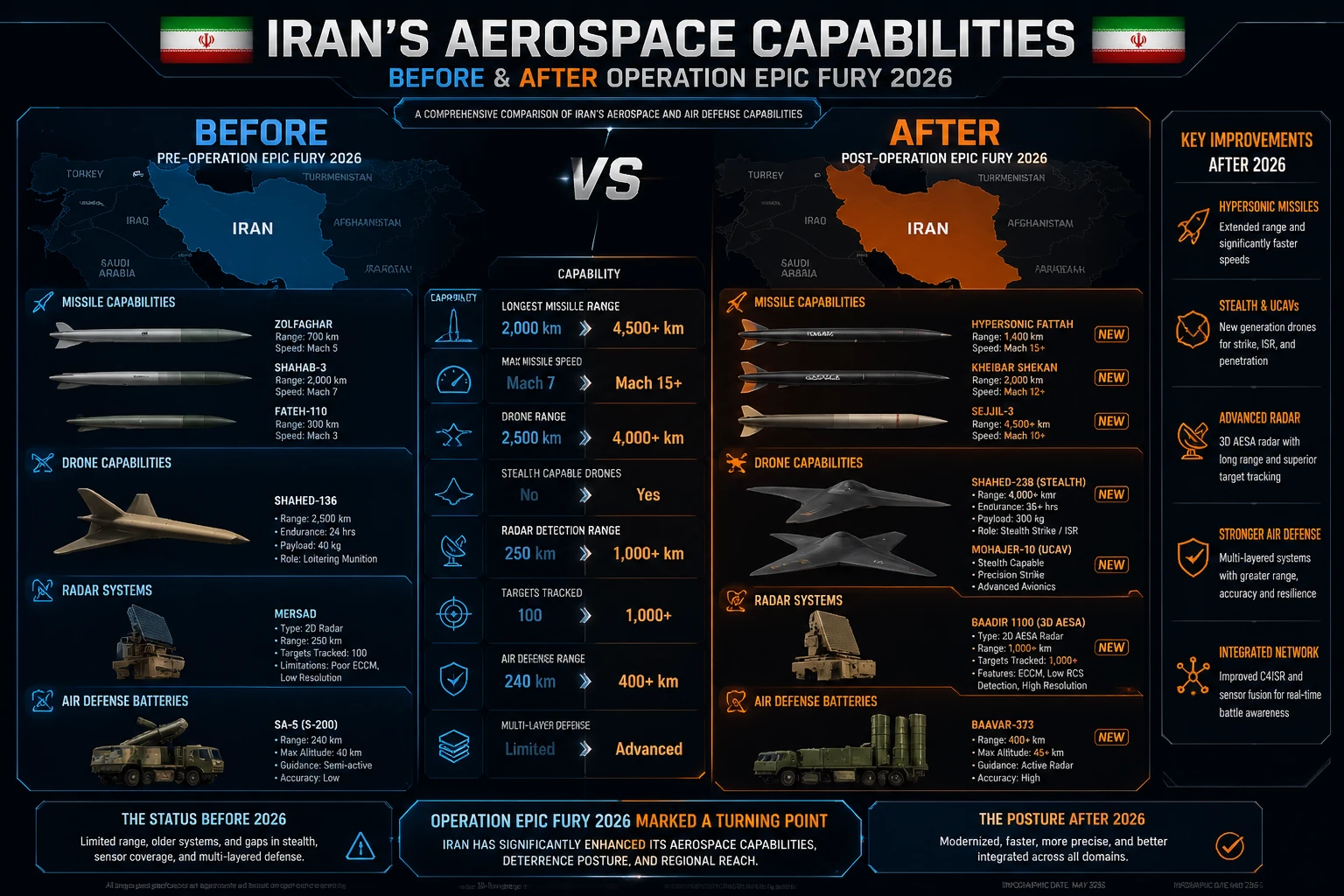
The first week of March 2026 witnessed the systematic dismantling of what had been the Middle East’s most formidable indigenous aerospace ecosystem. As the final sorties of Operation Epic Fury concluded, U.S. Central Command confirmed that American forces had struck more than 12,300 targets inside Iran. Chairman of the Joint Chiefs Gen. Dan Caine declared that coalition strikes had “destroyed Iran’s defense industrial base and their ability to reconstitute those capabilities for years to come,” claiming approximately 90 percent of Iranian weapons factories had been hit, including every factory that produced Shahed one-way attack drones and the guidance systems that powered them. Yet similar declarations had been made following the Twelve-Day War of June 2025, only for Tehran’s military-industrial complex to demonstrate remarkable regenerative capacity in the months that followed. This analysis examines the architecture of Iranian aerospace power as it existed on the eve of Epic Fury, the precise nature of the devastation inflicted upon it, and the uncertain contours of what may rise from the rubble.
Part I: The Aerospace Leviathan Before the Storm
The Strategic Calculus: Missiles and Drones as Air Force Substitutes
Long before the first bomb fell on February 28, 2026, Iran’s aerospace strategy had been shaped by a fundamental asymmetry. The Islamic Republic’s air force—an aging collection of pre-revolutionary American jets, Soviet-era interceptors, and Chinese imports—had been in terminal decline for decades. With approximately 37,000 personnel and 330-350 aircraft, the IRIAF operated a museum-piece fleet that included roughly 35-40 operational F-14A Tomcats, 30 MiG-29s, and a mix of F-4 Phantoms, F-5 Tigers, and Su-24 strike aircraft. Sanctions had choked off access to modern aircraft and spare parts, leaving many airframes grounded or cannibalized for components. The June 2025 Twelve-Day War had further degraded this force, with Israeli strikes destroying at least five F-14s on the ground and an Israeli F-35 achieving the first air-to-air kill by a manned fighter in decades, downing an Iranian aircraft.
In response to these structural constraints, Tehran had invested massively in alternatives that allowed it to project power and deter adversaries without contesting the skies. Iran’s missile and drone technology became a potent substitute for an air force, enabling strikes across the region and even further, into the Indian Ocean at ranges approaching 4,000 kilometers. This was not improvisation but doctrine. Iran’s emphasis on missile and drone technology was rooted in structural constraints, and over four decades, it had massively increased its inventory of cruise and ballistic missiles while more recently focusing with particular intensity on its drone program.
The Missile Arsenal: Quantity as a Quality of Its Own
On the eve of Epic Fury, Iran possessed one of the largest ballistic missile stockpiles in the Middle East, according to the U.S. Office of the Director of National Intelligence. The 2025 Worldwide Threat Assessment noted that Iran had “fielded a large quantity of ballistic and cruise missiles as well as UAS that can strike throughout the region and continues efforts to improve their accuracy, lethality, and reliability”. Iranian semi-official media reported in April 2025 that nine Iranian missiles could reach Israel, including the Kheibar and Hajj Qasem, and that the hypersonic Sejil could fly at more than 17,000 kilometers per hour.
The missile arsenal was both deep and diverse. The Shahab series, including the Kheibar Shekan, represented the backbone of Iran’s medium-range strike capability. Based on North Korean technology with a range of about 2,000 kilometers, the Kheibar Shekan was notable for being the only known Iranian ballistic missile capable of carrying MIRV payloads, though it required extended preparation time. Its warheads reportedly weighed between 700 and 1,000 kilograms of explosives. During attacks on Israel in October 2024 and June 2025, Iran had demonstrated the Kheibar Shekan’s capabilities, employing its high maneuverability to penetrate layered defenses.
The Fattah-1 and Fattah-2 represented Iran’s declared entry into the hypersonic age. Unveiled on June 6, 2023, the Fattah was described by the IRGC’s aerospace forces as capable of “penetrating through all missile defense systems”. Iranian sources claimed the Fattah approached hypersonic capabilities with sharp aerodynamic maneuverability, including outside the atmosphere, and carried a warhead of about half a ton. State television reported the missile could reach speeds of 13 to 15 times the speed of sound before impact, with a range of 1,400 kilometers. Western analysts offered more measured assessments, describing the Fattah series as comparable to regular MRBMs with a second stage featuring aerodynamic controls and a maneuverable nozzle that emulated a maneuverable re-entry vehicle.
Beyond these headline systems, Iran maintained a layered missile force. The Fateh lineage of solid-fuel, road-mobile short-range missiles included the 700-kilometer Zolfaghar and 1,000-kilometer Dezful. Liquid-fuel Shahab-3 derivatives such as the Emad and Ghadr reached approximately 2,000 kilometers, while the Khorramshahr family, with its latest Khorramshahr-4 iteration, carried an especially heavy warhead averaging 1,500 kilograms and was considered among the most accurate missiles in Iran’s arsenal.
Perhaps most significantly, in the period between the June 2025 Twelve-Day War and the onset of Epic Fury in February 2026, Iran had engaged in an intensive effort to rehabilitate and upgrade its ballistic missile arsenal. This included shifting from liquid fuel to solid fuel to cut launch preparation time from hours to minutes and reduce intelligence signatures, ramping up mass production of Kheibar and Fattah missiles, improving missile accuracy, and acquiring satellite-based intelligence. Russian cooperation played a crucial role in these upgrades, with reported efforts including integration of new radars, expansion of production lines, and the construction of underground launch sites. Some assessments suggested Iran had rebuilt its arsenal to approximately 1,500 operational missiles ready for immediate use.
The Drone Empire: Low-Cost Saturation Warfare
If missiles represented Iran’s strategic deterrent, drones embodied its operational art. Prior to the war, it was estimated that Tehran could produce 10,000 drones per month, with thousands more ballistic missiles in production. The Islamic Republic had built what analysts termed a “drone empire” capable of saturating even the most sophisticated air defense networks. This industrial capacity was supported by a vast and decentralized network: the Iranian deputy defense minister stated in November 2023 that the ministry worked with approximately 7,000 enterprises nationwide, about 40 percent of them knowledge-based companies.
The Shahed-136 was the workhorse of this arsenal. With a stated range of more than 2,000 kilometers, it gave Iran the ability to strike almost anywhere in the Middle East. The drone’s genius lay in its simplicity: an engine comparable to those found in vehicles, a body that could be constructed from composites, metal, wood, or even hard cardboard, and a guidance system that could operate autonomously or with human intervention in the terminal phase. Its low cost made it expendable, yet the damage it inflicted on expensive interceptor stockpiles—American THAAD and Patriot systems, Israeli Arrow, David’s Sling, and Iron Dome—represented a form of economic warfare.
The Arash-2, an upgraded version of the Kian-2 drone, represented a heavier class of suicide UAV. Entering service in 2020, it carried a 150-kilogram warhead and boasted a 2,000-kilometer strike range, specifically designed to reach Tel Aviv and Haifa. At approximately 4.5 meters in length and weighing around 2 tons, it could be launched from a regular car and manufactured with parts easier to smuggle than components for more sophisticated systems. During the conflict, Arash-2 drones struck Ben Gurion Airport and radar installations in the UAE, severely degrading coalition aerial support capabilities.
The Mohajer-6 served as a tactical reconnaissance and combat platform capable of carrying air-to-ground missiles for precision strikes. The Kaman-22, a wide-body combat drone, extended Iran’s reach to 3,000 kilometers with 24-hour endurance. Newer platforms included the jet-powered Shahed-238 and the Hadid-110, a high-speed suicide drone capable of 500 kilometers per hour with reduced radar signature due to non-metallic construction and angular design. Iran’s drone fleet demonstrated that quantity, simplicity, and distributed manufacturing could impose significant costs on technologically superior adversaries.
Air Defense: The Bavar-373 and the Layered Shield
While Iran conceded air superiority to U.S. and Israeli stealth aircraft, its air defense network was not negligible. The Russian S-300 PMU2 system, acquired in 2016, served as the backbone of long-range defense, capable of tracking multiple targets up to 200 kilometers away and threatening non-stealth aircraft and some ballistic missiles.
The Bavar-373 represented Iran’s premier indigenous air defense achievement. Development began in the early 2010s after Russia canceled an S-300 deal under Western pressure, and the system evolved through multiple iterations. By 2021, a new variant had been unveiled that Iranian officials claimed surpassed the capabilities of the Russian S-400. Tehran asserted that the Bavar-373 could detect targets at 450 kilometers and engage them at 300 kilometers using the Sayyad-4B missile. The system reportedly could intercept 100 targets at ranges exceeding 400 kilometers and altitudes up to 32 kilometers. During Eqtedar 1403 exercises, the Bavar-373 and S-300 were integrated into the nationwide air defense network for the first time, operating in tandem to counter high-altitude threats.
Yet the network had critical vulnerabilities. Integration between Cold War-era hardware and newer digital systems created “sensor-to-shooter” gaps that delayed reaction times during fast-paced modern conflict. More fundamentally, Iranian radars likely struggled to maintain weapons-grade locks on F-35 or F-22 aircraft, as advanced American stealth technology was specifically designed to evade the frequency bands used by most Iranian tracking radars. U.S. forces also possessed superior electronic warfare capabilities that could jam or spoof radar networks, with older Iranian systems like the Mersad particularly susceptible to widespread jamming. A massive volley of decoys, cruise missiles, and drone swarms could deplete Iranian interceptor stocks quickly, allowing follow-on strikes to penetrate.
The Space Dimension: Satellites and Strategic Ambition
Iran’s space program, while modest compared to major powers, provided critical capabilities and demonstrated indigenous launch vehicle expertise. The program achieved a significant milestone in December 2025, just two months before Epic Fury, when Iran launched three domestically built observation satellites—Kowsar 1.5, Paya, and Zafar-2—aboard a Russian Soyuz rocket from Vostochny Cosmodrome. The Kowsar 1.5 provided high-resolution imaging for agricultural and environmental monitoring; Zafar-2 was an advanced Earth-observation platform weighing 100 to 135 kilograms; and Paya, at 150 kilograms, was Iran’s most advanced domestically built imaging satellite. This launch represented the seventh Iranian satellite carried into space by Russia, underscoring the deepening strategic partnership between the two sanctioned powers. The space program’s dual-use nature—civilian on paper but providing critical launch vehicle expertise applicable to ballistic missile development—had long concerned Western observers.
The Industrial Ecosystem: Decentralized Mosaic Defense
What made Iran’s aerospace industry particularly resilient was not any single weapon system but the organizational architecture underpinning it. The “Decentralized Mosaic Defense” strategy, developed over two decades by the IRGC, dispersed command structures, weapons systems, and operational units across vast geographic and organizational lines so that military functions could continue even under intense attack.
Running parallel to the IRGC was the Ministry of Defense and Armed Forces Logistics (MODAFL), which oversaw Iran’s missile and drone industries through a decentralized model. MODAFL managed a network of state-run and quasi-private entities, including the Aerospace Industries Organization for missile research and production, and the Defense Industries Organization for conventional arms. The IRGC maintained its own weapons programs, most notably the Shahed Aviation Industries Research Center. This dual structure relied on vast networks of subsidiaries, suppliers, and front companies that acquired components while circumventing Western sanctions. The distributed nature of this ecosystem meant there was no single point of failure—a characteristic that would prove both a challenge for coalition targeteers and a source of residual resilience after the bombs stopped falling.
Part II: The Hammer Falls — Operation Epic Fury
The Opening Salvo: Decapitation and Infrastructure Destruction
When Operation Epic Fury commenced on February 28, 2026, it represented the most comprehensive aerospace assault ever mounted against a nation’s defense industrial base. The operation’s objectives, as articulated by President Donald Trump, included preventing Iran from acquiring a nuclear weapon, destroying Iran’s missiles, and “razing their missile industry to the ground”. The first 72 hours saw over 1,700 targets struck, with the coalition achieving near-total air supremacy within days. Supreme Leader Ayatollah Ali Khamenei was killed on the first day, triggering the activation of Iran’s Decentralized Mosaic Defense strategy.
U.S. and Israeli aircraft specifically targeted bases and equipment associated with Iran’s ballistic missile program. The B-2 Spirit fleet, operating from the continental United States and escorted by F-22 Raptors, delivered GBU-57 Massive Ordnance Penetrators against Iran’s deeply buried nuclear and missile facilities. The combination of stealth characteristics and massive penetrating payload made the B-2 the only platform capable of neutralizing Iran’s most heavily fortified targets, including the underground “missile cities” that had been constructed to protect ballistic missile stockpiles.
F-22s and F-35s systematically dismantled air defense nodes, with the F-35’s sensor fusion capabilities acting as the “nerve center” of the operation. Israeli F-35I “Adir” fighters, uniquely modified with conformal fuel tanks maintaining low-observable characteristics, penetrated hundreds of kilometers into Iranian territory to deliver precision munitions on critical infrastructure. Iranian S-300 and Bavar-373 systems never achieved a weapons-grade lock on Israeli aircraft.
Attrition of Air Power
Iran’s already decrepit air force was further decimated. The IRIAF’s aging fleet, long crippled by sanctions that had restricted access to modern aircraft and parts, suffered additional losses in the opening days. Aircraft that had survived the June 2025 Twelve-Day War were struck on the ground or shot down when they attempted to challenge coalition air patrols. The air force that had once been the pride of the Shah’s military modernization was reduced to a symbolic remnant.
Missile Infrastructure: Destruction and Disruption
The coalition’s targeting prioritization focused relentlessly on Iran’s missile industrial base. Gen. Caine’s claim that approximately 90 percent of weapons factories were struck included specific targeting of every Shahed production facility and every factory producing guidance systems. Mobile missile launchers, a central concern for intelligence officials seeking to locate and disable them in real time before launch, were hunted with particular intensity. The shift Iran had made toward solid-fuel missiles, which reduced launch preparation time from hours to minutes, made these systems harder to detect before launch but did not eliminate the challenge of finding and destroying them.
U.S. intelligence assessments conducted during and immediately after the operation provided a more nuanced picture than the triumphalist public statements. Approximately half of Iran’s missile launch systems remained operational, though the assessment noted that this figure may have included launchers currently unusable, such as those buried underground by airstrikes but not fully destroyed. The intelligence indicated that roughly half of Iran’s drone capacity—amounting to thousands of units—remained intact. Notably, many of Iran’s coastal defense cruise missiles were not significantly degraded, reflecting a U.S. strategic decision not to prioritize coastal military infrastructure in the air campaign. These missiles remained a crucial asset for threatening shipping in the Strait of Hormuz.
The Limits of Destruction: What Survived
The survival of significant capabilities despite the unprecedented scale of the air campaign can be attributed to several factors. Iran’s Decentralized Mosaic Defense strategy, while unable to prevent the destruction of fixed infrastructure, did preserve some operational capacity. The distributed nature of manufacturing, with thousands of enterprises spread across the country, meant that destroying “90 percent of weapons factories” might still leave hundreds of smaller, less visible production nodes intact. Underground facilities, while not invulnerable to penetrating munitions, were more likely to survive than above-ground installations.
The coalition’s own strategic choices also shaped the outcome. The decision not to prioritize coastal defense infrastructure left Iran’s ability to threaten maritime traffic largely unimpaired. Some targets were simply too numerous to strike comprehensively. A senior European official noted that Iran’s ability to produce more drones was limited “not necessarily by a lack of sites or materials, but because strikes have disrupted the organization and coordination needed for large-scale manufacturing”. This disruption was significant but not absolute. The official’s observation suggested that Iran retained both the physical infrastructure and material inputs for drone production; what had been degraded was the organizational capacity to operate at the pre-war scale.
The Russian Dimension: A Strategic Realignment
One of the most significant and underappreciated consequences of Epic Fury concerned Iran’s relationship with Russia. The two countries had deepened their military-technical cooperation substantially in the years leading to the conflict, culminating in a $1.75 billion deal in early 2023 allowing Russia to produce Shahed-136 drones domestically at the Alabuga special economic zone in Tatarstan. This partnership had enabled Russia to localize drone production, with analysts estimating that 90 percent of production stages occurred in Russia or other Russian facilities by the time of Epic Fury.
The strikes on Iran’s own drone production capabilities during the June 2025 Twelve-Day War and subsequently during Epic Fury created an ironic reversal. Western intelligence sources claimed that Russia’s expansion and complete integration of Iranian drone technology into its own manufacturing base caused a rift between Tehran and Moscow. The Iranians had grown impatient with what they perceived as insufficient Russian support during Israel’s campaigns. Analysts suggested that the Russian factory at Alabuga would eventually allow Moscow to “export an updated and battle-tested version of the drone it originally imported from Iran—maybe even to Tehran itself”. This marginalized Iran’s position, transforming it from a technology provider to a potential customer. Much of Iran’s drone production capabilities having been targeted during the wars, Russia might find itself in the position of supplying Iran with drones produced at Alabuga.
This represented a profound strategic shift. Before Epic Fury, Iran had leveraged its drone technology as a diplomatic and military asset, exporting to Russia and other partners while building indigenous capacity. After Epic Fury, Iran faced the prospect of dependency on the very partner it had once supplied—a reversal that underscored the devastating impact of the strikes on its industrial base.
Part III: The New Landscape — Iran’s Aerospace Industry After Epic Fury
Immediate Post-Conflict Assessments: Between Triumphalism and Reality
In the days following the cessation of major combat operations, both sides advanced competing narratives. IDF Chief of Staff Lt.-Gen. Eyal Zamir declared that the IDF’s achievements were “unprecedented and historic” and that “Iran before this war is not the same Iran as now; it is much weaker”. Gen. Caine asserted that the strikes had destroyed Iran’s ability to reconstitute capabilities “for years to come”.
U.S. intelligence assessments, however, presented a more measured view of Iran’s remaining military strength, contrasting with broad claims of victory made publicly by the administration. Sources familiar with the intelligence emphasized that Iran retained a significant offensive capability: “They are still very much poised to wreak absolute havoc throughout the entire region”. The assessment that approximately half of missile launch systems remained operational, along with thousands of drones and largely intact coastal defense cruise missile capabilities, indicated that while Iran had been severely weakened, it was far from disarmed.
The Jerusalem Post’s analysis captured the essential tension: similar remarks about destroying Iran’s defense industrial base had been made by Israel in the 12-Day War just nine months earlier. Yet by February 2026, there were still thousands of targets in Iran for both militaries to hit. The question was not whether Iran would attempt to reconstitute its capabilities—its leadership, “now even more extreme than before the war,” might double down on missile and drone development during any ceasefire—but rather how quickly and effectively it could do so.
The Resilience Question: Can Iran Rebuild?
The central question facing defense planners and intelligence analysts is the speed and scale of Iran’s likely aerospace industry recovery. Several factors suggest that full reconstitution to pre-Epic Fury levels will be challenging and time-consuming, while others indicate that meaningful recovery will occur more rapidly than the “years to come” predicted by Gen. Caine.
Factors Favoring Recovery:
First, Iran’s Decentralized Mosaic Defense strategy, while insufficient to prevent massive infrastructure destruction, does preserve a foundation for rebuilding. The distributed network of thousands of knowledge-based companies, suppliers, and front companies did not vanish with the destruction of major factories. Many smaller production nodes likely survived. The senior European official’s assessment that production was limited “by a lack of sites or materials, but because strikes have disrupted the organization and coordination needed for large-scale manufacturing” suggests that the physical and material foundation for production remains partially intact. Organizational capacity can be restored more quickly than physical infrastructure can be rebuilt.
Second, Iran’s missile and drone programs are long-term strategic projects that have advanced through close to half a century, surviving periods of both conflict and calm. These systems are central to Iran’s national security doctrine, and the regime will prioritize their reconstitution regardless of economic costs or international pressure. The pattern established after the June 2025 Twelve-Day War—in which Iran shifted to solid-fuel missiles, ramped up mass production, and improved accuracy within nine months—demonstrates the regime’s commitment and capability for rapid recovery.
Third, ceasefires and periods of reduced kinetic activity can ease pressure, allowing Iran to clandestinely reorganize, restock, and even expand weapons procurement. When immediate operational demands decrease, resources can shift toward testing and integration. This pattern is visible in Iran’s missile and drone programs, which have advanced despite international sanctions and military pressure.
Factors Impeding Recovery:
Countervailing forces will constrain Iran’s ability to return to pre-war production levels quickly. The sheer scale of destruction inflicted by Epic Fury—12,300 targets struck, 90 percent of weapons factories claimed destroyed—far exceeded that of the June 2025 Twelve-Day War. The physical infrastructure required for large-scale missile and drone production cannot be replaced overnight. Specialized equipment, precision tooling, and the skilled workforce needed to operate them have been lost. Reconstituting these elements will require years, not months.
Second, the disruption to organization and coordination identified by the European official represents a genuine bottleneck. Even if materials and smaller production nodes remain available, the complex logistics of integrating components from thousands of dispersed suppliers into finished weapons systems cannot be replicated easily under wartime conditions or in the immediate aftermath of massive infrastructure strikes. The “just-in-time” nature of modern manufacturing makes the entire system vulnerable to the loss of key nodes.
Third, the strategic realignment with Russia introduces new complications. Iran may find itself dependent on Russian production capacity at precisely the moment it needs to demonstrate indigenous resilience. The tension between the two partners, revealed in the aftermath of the June 2025 war, may limit Tehran’s willingness to rely on Moscow for critical capabilities. The prospect of being reduced to importing drones from a country that had once been its customer represents a strategic humiliation that the regime will seek to avoid, but may be unable to escape in the short term.
Finally, the loss of senior leadership, including Supreme Leader Khamenei and National Security Council head Ali Larijani, creates organizational and decision-making disruptions that extend beyond the aerospace sector. While the Decentralized Mosaic Defense strategy was designed to preserve military functionality even under decapitation strikes, the political and strategic guidance required for major industrial reconstitution efforts may be impaired during a leadership transition period.
The New Balance: What Capabilities Remain?
The post-Epic Fury Iranian aerospace industry is neither destroyed nor fully functional. It exists in a degraded but still dangerous state, with the following residual capabilities:
Missile Forces: Approximately half of launch systems remain operational, though some proportion of these may be buried or otherwise degraded. The stockpile of ballistic missiles has been reduced but not eliminated. Iran retains a substantial missile inventory along with remaining launch infrastructure, sufficient to threaten regional adversaries. The coastal defense cruise missile force remains largely intact, preserving Iran’s ability to threaten shipping in the Strait of Hormuz and potentially close this vital waterway.
Drone Forces: Thousands of one-way attack drones remain in inventory. While production capacity has been severely curtailed, existing stockpiles provide a limited ability to conduct saturation attacks against regional targets. The distributed, workshop-based manufacturing model that served Iran well before the war may enable some level of continued production from surviving smaller facilities, though not at the 10,000-units-per-month rate achieved before the conflict.
Air Defense: The Bavar-373 and S-300 systems have suffered losses but retain some operational capability. The integration of these systems into a nationwide network, demonstrated in pre-war exercises, provides residual coverage of key sites. However, the fundamental vulnerabilities to stealth technology and electronic warfare remain unaddressed.
Space Program: Iran’s space launch capabilities, demonstrated most recently with the December 2025 Soyuz launch of three domestically built satellites, may survive the conflict relatively intact if the launch infrastructure was not targeted. The program’s dual-use nature and Russian partnership may preserve it as a foundation for future missile development. The expertise gained in satellite development and launch vehicle technology cannot be destroyed by airstrikes alone.
Industrial Base: The physical infrastructure for large-scale production has been devastated, but the knowledge base, human capital, and smaller distributed production nodes survive. Iran’s aerospace engineers, technicians, and scientists—the intellectual foundation of the industry—were not eliminated by the strikes. The 7,000 enterprises that comprised the defense industrial ecosystem have been reduced but not extinguished. The regime’s ability to reconstitute depends on how effectively it can reorganize these surviving elements.
Strategic Implications: A Weakened but Unbroken Foe
Operation Epic Fury achieved its immediate objectives: Iran’s defense industrial base was systematically dismantled, its ability to produce weapons at pre-war scale was destroyed, and its missile and nuclear infrastructure was degraded. Iran is “much weaker” than before the war, as Lt.-Gen. Zamir stated. The country’s capacity to project conventional military power has been significantly reduced for the foreseeable future.
Yet the operation did not eliminate Iran as a strategic threat. The regime retains sufficient residual capabilities to inflict significant damage on regional adversaries. The coastal defense cruise missile force can threaten global energy supplies through the Strait of Hormuz. Thousands of remaining drones can still saturate air defenses in coordinated attacks. The ballistic missile stockpile, though reduced, remains capable of striking Israel and U.S. bases in the region. And the fundamental drivers of Iranian aerospace development—structural constraints on conventional air power, a national security doctrine centered on asymmetric capabilities, and a regime determined to preserve its deterrent—remain unchanged.
The most important strategic question may not be how quickly Iran can rebuild its factories, but how the experience of Epic Fury will shape the next generation of Iranian aerospace development. A month of war will have helped Iran’s battered yet resilient military industry learn for the next war. The regime may accelerate its shift toward even more distributed, harder-to-target production models. It may invest more heavily in underground facilities and mobile systems. It may deepen its reliance on external partners, or alternatively, double down on indigenous capabilities to reduce vulnerability to partner abandonment. And it will almost certainly accelerate its pursuit of hypersonic weapons and other advanced capabilities designed to penetrate the missile defense systems that performed so effectively during the conflict.
Conclusion: The Ashes of Ambition
Operation Epic Fury represented a watershed moment in the history of aerospace warfare—a demonstration that even a sophisticated, distributed, and resilient defense industrial base can be systematically dismantled by overwhelming stealth-enabled air power. Iran’s aerospace industry, painstakingly constructed over four decades of sanctions and isolation, was reduced to a fraction of its former capacity in a matter of weeks.
Yet the ashes of this ambition still smolder. The knowledge, the human capital, the strategic imperative, and the residual material capacity for reconstitution all survive. The history of Iran’s aerospace development is one of adaptation under pressure, of finding pathways around obstacles, of turning weakness into asymmetric strength. The regime that built a drone empire from smuggled components and reverse-engineered technology will not abandon its strategic ambitions because of a single military defeat, however devastating.
The true legacy of Epic Fury will not be determined in the immediate aftermath of the bombing campaign, but in the years that follow. Will Iran’s aerospace industry rise again, Phoenix-like, from the rubble of its factories? Or has the hammer blow of coordinated U.S. and Israeli air power permanently shattered the foundation of the Islamic Republic’s asymmetric military power? The answer will shape the security of the Middle East for a generation.
