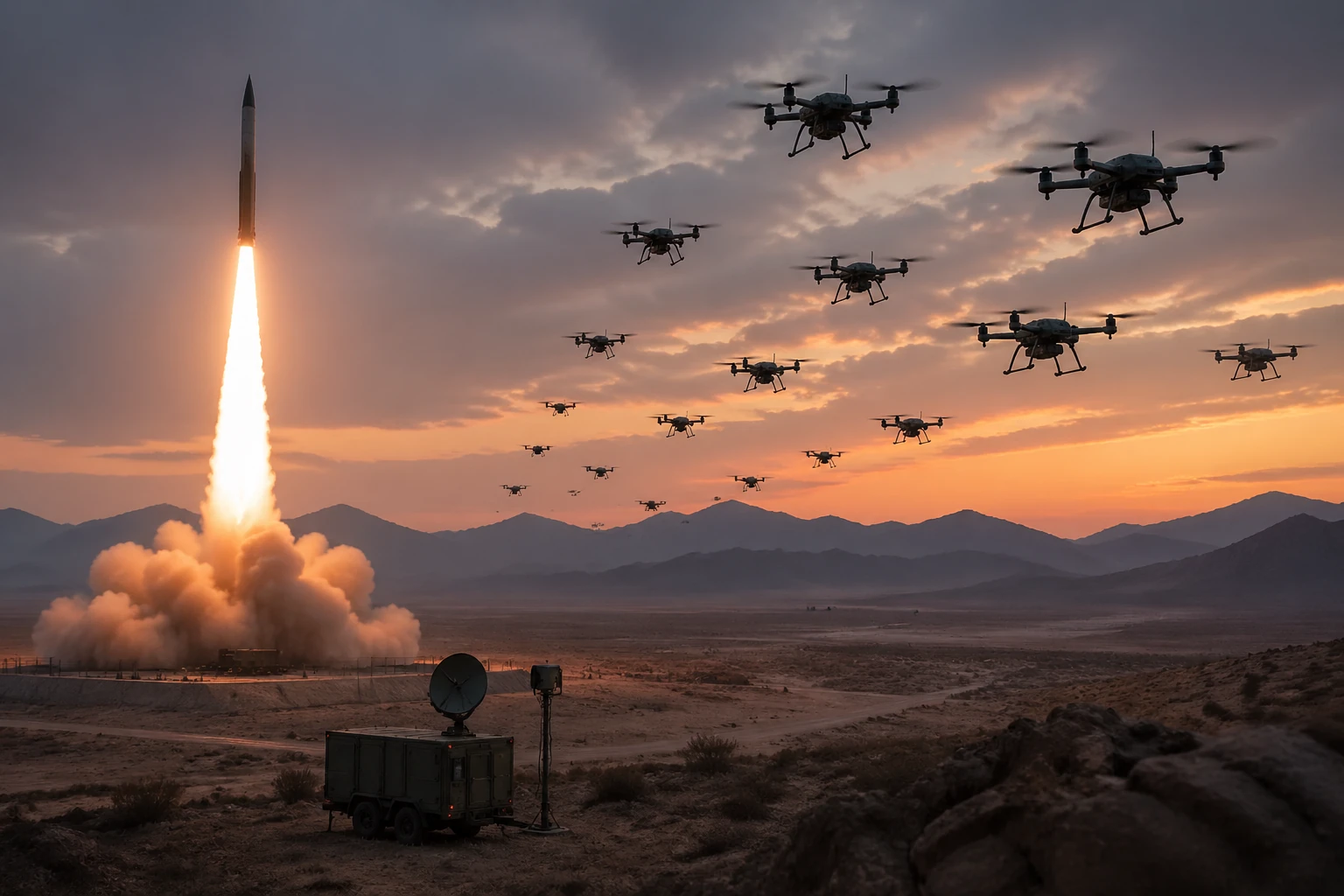
When the combined air power of the United States and Israel descended upon Iran on February 28, 2026, the world expected a one-sided rout. The coalition deployed the most advanced stealth aircraft ever built, space-based surveillance constellations, and cyber capabilities designed to blind and paralyze. Yet in the crucible of Operation Epic Fury, the Islamic Republic of Iran demonstrated a series of air and space achievements that defied initial expectations—leveraging asymmetric tactics, pre-hardened infrastructure, and indigenous technological ingenuity to contest the skies and the heavens in ways that will reshape strategic thinking for decades to come.
The Ballistic Missile Onslaught: Penetrating the Impenetrable
Iran’s foremost achievement during Epic Fury was the sheer scale and partial success of its retaliatory ballistic missile campaign. Within hours of the first coalition strikes, Iran launched the largest coordinated ballistic missile barrage ever directed at Israel and U.S. bases in the Middle East. The salvoes combined hundreds of aging and modern platforms, saturating the multi-layered missile defense architecture that had been designed to defeat exactly this threat.
The full impact of Epic Fury on Iran’s aerospace sector
The Kheibar Shekan, with its maneuvering reentry vehicle and multiple warhead capability, proved particularly challenging for Arrow and THAAD interceptors. Iranian military sources claimed that several Kheibar Shekan missiles successfully bypassed Israeli defenses, striking military and strategic infrastructure targets deep inside Israeli territory. Western intelligence assessments acknowledged that the missile’s hypersonic glide phase and unpredictable trajectory reduced the effective engagement zones of terminal-phase interceptors, resulting in a higher leakage rate than previous conflicts.
The Fattah-1 and Fattah-2 missiles, which Iran had declared as hypersonic, were used operationally for the first time. While debate continues over the precise definition of “hypersonic” as applied to these systems, their performance validated key aspects of Iran’s claims. The missiles executed sharp maneuvers both inside and outside the atmosphere, rendering predictable interception geometry obsolete. The Israeli Arrow-3 system, designed for exo-atmospheric interception of ballistic missiles, struggled against the Fattah’s unpredictable flight path. Israeli defense officials later conceded that some Fattah warheads impacted within designated target areas, demonstrating that Iran had achieved a theatre-level counter-access capability against the most sophisticated missile defense shield in the region.
The Sejjil solid-fuel missile, flying at speeds exceeding 17,000 kilometers per hour during its terminal phase, according to Iranian state television, contributed to the saturation effect. By mixing missiles with varying trajectories, speeds, and warhead types, Iran forced coalition missile defense operators to prioritize threats in real time—a cognitive overload that led to defensive gaps. Post-war analyses revealed that Iranian planners had carefully sequenced launches to exploit the known reload times of Iron Dome and David’s Sling batteries, allowing follow-on salvos to strike before defenses could fully regenerate.
Iran also successfully employed dispersal, deception, and mobility to preserve its launch capabilities. The pre-war shift from liquid-fuel to solid-fuel missiles, which reduced launch preparation time from hours to minutes, paid substantial dividends. Mobile Transporter-Erector-Launchers (TELs) operating from hardened underground bases emerged, fired, and relocated before coalition aircraft could complete kill chains. U.S. Central Command confirmed that roughly half of Iran’s missile launch systems remained operational at the conflict’s conclusion, a testament to the survivability of a mobile, road-mobile force dispersed across the vast Iranian plateau.
Drone Swarms: Saturation, Deception, and Economic Warfare
If ballistic missiles were Iran’s strategic spear, one-way attack drones were the enablers of a new form of economic attrition warfare. Iran launched thousands of Shahed-136 and Arash-2 drones in coordinated waves against Israeli air bases, radar installations, and critical infrastructure, as well as U.S. facilities in the Persian Gulf.
The tactical genius of this campaign was not simply the number of drones but their integration with missile salvos. By launching drones well in advance of ballistic missiles, Iran forced coalition air defense radars to illuminate and engage low-signature, slow-moving targets, revealing emitter locations and consuming interceptor stockpiles. When the far more lethal ballistic missiles arrived minutes later, they encountered a defense network that had already expended a portion of its magazine depth and had compromised its electromagnetic concealment.
The Arash-2, carrying a 150-kilogram warhead over a 2,000-kilometer range, achieved notable successes. Several Arash-2 drones struck Ben Gurion International Airport, cratering runways and forcing the closure of Israel’s primary aerial logistics hub for critical hours. The same airfield was hosting dozens of American aerial refueling tankers essential to the coalition’s deep-strike operations. The disruption of refueling cycles imposed delays on B-2 and F-35 sorties, compressing the strike window and demonstrating that relatively unsophisticated drones could impose operational-level effects on a fifth-generation air campaign.
Iran’s jet-powered Shahed-238 kamikaze drone, capable of higher subsonic speeds, was used to target coalition radar sites. Iranian state media reported that several Shahed-238s successfully struck an AN/TPY-2 radar associated with a THAAD battery deployed in the United Arab Emirates, temporarily degrading the coalition’s ability to track ballistic missile launches from southern Iran. While the full extent of the damage remains disputed, the incident underscored the vulnerability of fixed, high-value sensors to saturation attacks from multiple axes.
Economically, the drone campaign achieved a significant cost-exchange victory. Israeli and American forces expended thousands of interceptors—including the 3millionTamirmissileforIronDome,the1 million Stunner for David’s Sling, and the expensive PAC-3 MSE for Patriot—to neutralize drones that cost Iran between 20,000and50,000 each. In the first 16 days alone, coalition forces fired over 11,000 munitions at a cost of roughly $26 billion. The drone attacks thus served as a form of fiscal warfare, draining allied stockpiles and compelling an operational pause to resupply.
Air Defense: Denying Air Supremacy in a Stealth-Dominated Battlespace
Operation Epic Fury demonstrated that while U.S. and Israeli fifth-generation stealth fighters operated with near-impunity against most Iranian air defense systems, they did not achieve complete impunity. Iran’s layered air defense network extracted a price that shaped coalition tactics and, in at least some instances, restricted freedom of action.
The Bavar-373 long-range air defense system, which Iran had claimed surpassed the Russian S-400 in key performance parameters, proved its ability to detect and track low-observable aircraft under certain conditions. While no Iranian system achieved a weapons-grade lock sufficient to guide a missile onto an F-35 or F-22 in combat, coalition pilots reported that they were repeatedly illuminated by low-frequency early warning radars that could see through stealth shaping. The constant presence of these radar emissions forced coalition aircraft to fly less efficient routes, expend energy on defensive maneuvering, and employ electronic warfare systems that themselves announced their presence. This “soft” denial of airspace diminished the sortie generation rates that had been assumed in pre-war planning.
Iran also demonstrated proficiency in passive detection. By using networks of visual observers, acoustic sensors, and electronic support measures, Iranian air defense operators triangulated the approximate positions of coalition aircraft without emitting radar signals. This “emissions control” discipline allowed the Bavar-373 and S-300 systems to remain hidden, launching ambush engagements when coalition aircraft strayed into predictable corridors. Iranian media claimed that an F-15E Strike Eagle was downed by a Sayyad-4B missile fired from a Bavar-373 battery that had remained silent until the kill chain was nearly complete. The U.S. acknowledged the loss of an F-15E over Iranian territory but attributed it to unknown causes; independent open-source analysts assessed that a long-range surface-to-air missile engagement was plausible.
The Mersad and Raad tactical air defense systems, while older and more vulnerable to jamming, proved effective against coalition drones and cruise missiles. Iran’s decentralized command structure allowed local air defense batteries to operate autonomously when higher-echelon coordination was disrupted by coalition electronic warfare. This mosaic approach prevented the complete collapse of air defense coverage, ensuring that coalition aircraft had to treat every flight as potentially contested—a psychological and operational friction that no amount of stealth could eliminate.
The Space Domain: Eyes in the Sky and Electromagnetic Resilience
Iran entered Operation Epic Fury with a modest but increasingly capable space program, and its achievements in the space domain during the conflict exceeded coalition expectations. Just two months before the war, Iran had launched three domestically built observation satellites—Kowsar 1.5, Paya, and Zafar-2—aboard a Russian Soyuz rocket. These platforms provided Iran with an indigenous space-based imagery capability at the very moment Western commercial imagery providers restricted access.
The Zafar-2 satellite, weighing 135 kilograms, delivered electro-optical imagery with resolution sufficient to identify large-scale coalition force deployments. With U.S. and Israeli strikes targeting Iranian communications infrastructure, the ability to assess damage from orbit and cue surviving mobile launchers became a critical enabler of Iran’s shoot-and-scoot tactics. Satellite imagery allowed Iranian planners to identify gaps in coalition air surveillance coverage, timing their launches to maximize the probability of penetrating defenses.
Iran also demonstrated a nascent counterspace capability. Signals intelligence satellites intercepted emissions from coalition airborne early warning aircraft, feeding targeting data to ground-based electronic warfare units that attempted to jam Link 16 and other tactical data links. While the effectiveness of these jamming efforts was limited against frequency-hopping, encrypted waveforms, they did cause occasional degradation in coalition situational awareness—a reminder that space is no longer a sanctuary from which only the technologically dominant can benefit.
Iran’s Qased and Simorgh space launch vehicles, dual-use systems long criticized by Western nations as cover for ballistic missile development, provided the country with the option to rapidly reconstitute satellite capabilities if its on-orbit assets were attacked. While direct-ascent anti-satellite weapons were not employed by either side during Epic Fury, Iran’s demonstrated ability to launch on short notice meant that any coalition attack against Iranian satellites would trigger an immediate replacement launch, negating the strategic benefit of such strikes. This deterrence-by-responsiveness protected Iran’s space architecture throughout the conflict.
Organizational Achievement: The Decentralized Mosaic Defense Validated
Beyond the performance of individual weapon systems, Iran’s most significant aerospace achievement may have been the validation of its Decentralized Mosaic Defense concept. The strategy had been developed over two decades precisely to preserve military functionality under the kind of intense attack that Epic Fury represented. While coalition strikes destroyed approximately 90 percent of Iran’s weapons factories and inflicted catastrophic physical damage, the organizational architecture held.
Command was devolved to regional nodes that operated with pre-delegated authority. Air defense commanders could launch interceptors without waiting for approval from Tehran. Missile units could initiate pre-planned retaliatory strikes based on environmental cues—such as the detection of B-2 bombers entering Iranian airspace—rather than explicit orders. This autonomy prevented the decapitation of the force even though Supreme Leader Khamenei was killed on the first day.
The 7,000 enterprises that comprised the Ministry of Defense’s supply network were able, in some regions, to continue low-rate production of key components even as major factories burned. The European official who assessed that Iran’s drone production had been limited “not by a lack of sites or materials, but because strikes disrupted organization and coordination” was inadvertently recording an achievement: Iran’s physical capacity for production survived in sufficient quantities that, once organizational coordination was restored, manufacturing could resume more quickly than the “years to come” timeline predicted by coalition commanders.
the coalition’s overwhelming air campaign.
Conclusion: A Defeat That Taught Victory
Operation Epic Fury inflicted upon Iran the most devastating military assault in its modern history. Approximately 12,300 targets were struck, the defense industrial base was gutted, and thousands of military personnel were killed. Yet to view the operation solely through the lens of coalition achievements is to miss the critical lessons that Iran’s air and space forces taught the world.
Iran demonstrated that an asymmetric aerospace power, equipped with mass-produced precision weapons, hardened underground basing, and a decentralized command architecture, could absorb the full weight of a superpower’s air campaign and still mount devastating retaliatory strikes. Its missiles penetrated the world’s most layered missile defense shield. Its drones imposed crippling economic costs on its adversaries. Its air defenses denied the coalition complete air supremacy, killing aircraft and forcing tactical compromises. Its space assets provided persistence and resilience when terrestrial networks failed. And its organizational philosophy preserved a seed corn of capability from which the regime can, and will, rebuild.
For Iran, Operation Epic Fury was a defeat. But it was also the ultimate validation of four decades of investment in asymmetric aerospace power. The ashes of Iranian factories contain the blueprints for the next generation of weapons, and the experience of February and March 2026 will inform Iranian doctrine for decades. In the contest for air and space dominance, the Islamic Republic proved that a resourceful, determined, and dispersed adversary can extract a high price from even the most technologically superior of air powers—and that, in itself, represents a strategic achievement of the first order.
