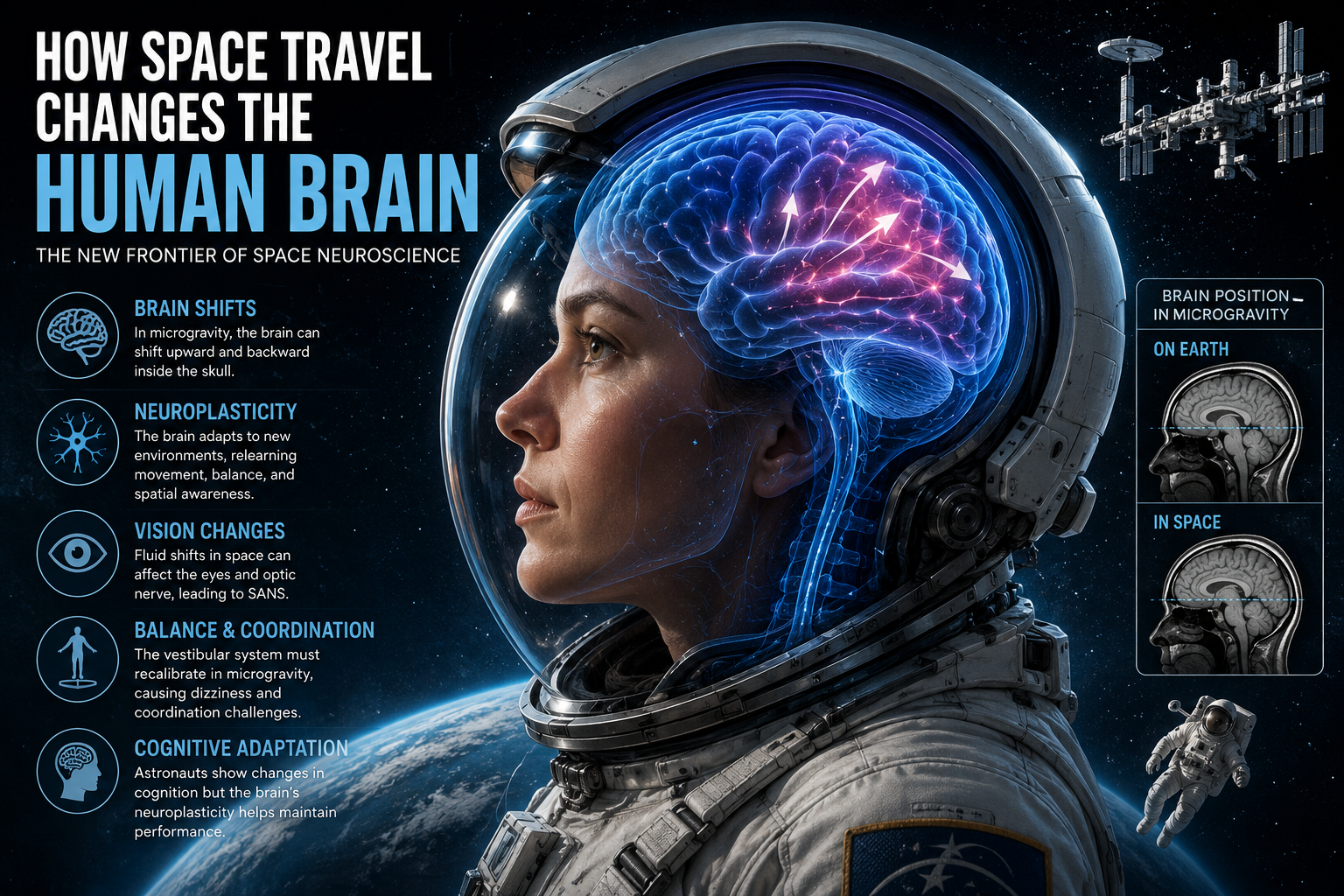
Space exploration has always pushed the limits of human capability. As missions extend beyond low Earth orbit and humanity prepares for long-term stays on the Moon and future journeys to Mars, scientists are discovering that one of the most affected organs in space is the human brain.
Recent research reveals that living in microgravity doesn’t simply change how astronauts move and work—it physically alters the brain itself. From shifting brain structures to changes in sensory processing and neuroplasticity, space neuroscience is becoming a critical field for the future of human spaceflight.
What Happens to the Brain in Space?
On Earth, gravity constantly influences how fluids move through our bodies. In space, the absence of gravity causes fluids to shift toward the head. This redistribution affects pressure within the skull and may contribute to a range of neurological changes.
Scientists have observed that astronauts experience:
- Changes in brain position within the skull
- Altered sensory and motor processing
- Vision-related complications
- Balance and coordination challenges
- Cognitive adaptation to microgravity
These effects become increasingly important as mission durations grow longer.
Brain Shifts in Microgravity
One of the most surprising discoveries in recent years is that astronauts’ brains physically move during spaceflight.
MRI studies of astronauts have shown that the brain can shift upward and backward inside the skull after spending extended periods in microgravity. Researchers found that the longer astronauts remain in space, the greater these structural changes can become.
While these shifts do not appear to cause severe cognitive impairment, they highlight how dramatically the human body adapts to environments it was never designed to inhabit.
Why Does This Matter?
Future missions to Mars could last two to three years. Understanding how prolonged space exposure affects brain structure is essential for ensuring astronaut safety, decision-making, and mission success.
The Role of Neuroplasticity
The human brain is remarkably adaptable.
Scientists describe this adaptability as neuroplasticity—the brain’s ability to reorganize itself in response to new environments and challenges.
Spaceflight forces the brain to relearn fundamental tasks such as:
- Movement
- Spatial awareness
- Hand-eye coordination
- Balance
- Orientation
Because gravity-based cues disappear in orbit, astronauts must develop entirely new sensory strategies.
Researchers believe that neuroplasticity helps astronauts maintain performance despite the unusual conditions of space. However, long-term neurological consequences remain an active area of investigation.
Spaceflight and Sensorimotor Function
Many astronauts report dizziness, motion sickness, and coordination difficulties when arriving in space or returning to Earth.
This happens because the vestibular system—the body’s balance mechanism located in the inner ear—depends heavily on gravity.
In microgravity, the brain receives conflicting information from the eyes, muscles, and vestibular system. As a result, astronauts must recalibrate how they perceive movement and orientation.
Studies show that some neural adaptations can persist for weeks or even months after returning to Earth.
Spaceflight-Associated Neuro-Ocular Syndrome (SANS)
One of the most significant neurological challenges facing astronauts is Spaceflight-Associated Neuro-Ocular Syndrome (SANS).
SANS is believed to be linked to fluid shifts that increase pressure around the eyes and brain.
Symptoms may include:
- Vision changes
- Eye structure alterations
- Optic nerve swelling
- Reduced visual performance
NASA and international researchers are actively studying these effects because clear vision is essential for future deep-space missions.
The Challenge of a Mission to Mars
A journey to Mars represents one of humanity’s greatest scientific ambitions.
However, astronauts traveling to Mars will face:
- Extended exposure to microgravity
- Increased cosmic radiation
- Communication delays with Earth
- Isolation and confinement
- Continuous cognitive demands
Space medicine experts increasingly recognize that protecting brain health may be as important as protecting muscles and bones.
Advanced monitoring systems, AI-assisted diagnostics, wearable sensors, and personalized health protocols are expected to play major roles in future missions.
Why Space Neuroscience Benefits Earth
Research conducted for astronauts often produces breakthroughs that benefit people on Earth.
Space neuroscience may contribute to:
- Better understanding of aging-related brain changes
- Improved rehabilitation techniques
- Advances in neurodegenerative disease research
- New treatments for balance disorders
- Enhanced brain-monitoring technologies
The challenges of spaceflight provide scientists with a unique opportunity to study how the brain responds to extreme environments.
The Future of Human Brain Research in Space
As humanity moves toward a permanent presence beyond Earth, understanding the brain’s response to space will become increasingly important.
Future lunar bases, Mars missions, and commercial space travel will depend on our ability to protect cognitive performance and neurological health.
The emerging field of space neuroscience is revealing a simple but profound truth: when humans travel into space, the brain must evolve alongside the mission.
The next giant leap for humanity may not be measured in kilometers traveled, but in how well we understand the most complex organ in the universe—the human brain.
