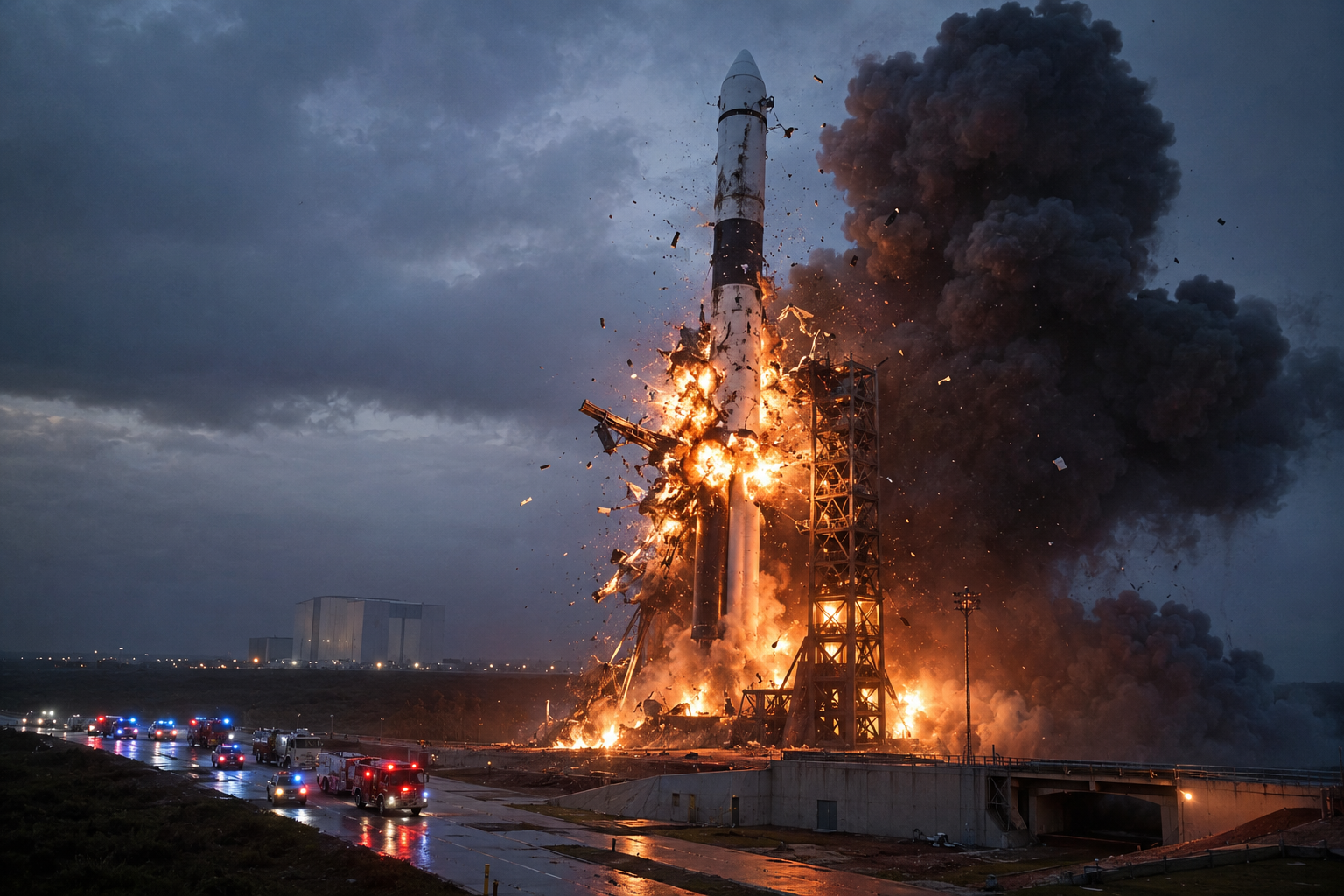
On May 28, 2026, Blue Origin’s New Glenn rocket exploded during a pre-launch “hotfire” engine test at Space Launch Complex 36. The rocket—standing 98 meters tall, the most powerful in Blue Origin’s fleet—was destroyed, and the launch pad was left “practically destroyed,” with engineers estimating at least six months of repairs. No one was injured, but the damage was catastrophic. Jeff Bezos took to X, acknowledging the incident and vowing to “rebuild whatever needs rebuilding and get back to flying”.
The explosion couldn’t have come at a worse time. Just days earlier, on May 26, NASA had awarded Blue Origin a $188 million contract to deliver lunar rovers to the Moon’s south pole using the Mark 1 cargo lander, “Endurance”. That contract is now in jeopardy. The New Glenn rocket was also scheduled to launch Blue Origin’s first Blue Moon lunar lander later this year, and the pad damage could delay that mission by months.
For Amazon, the stakes are equally high. The explosion directly threatens Amazon’s satellite internet constellation, which must deploy half of its 3,200 low-Earth orbit satellites by July 2026 to meet regulatory deadlines. With New Glenn grounded, Amazon now faces a scramble to secure alternative launch providers. SpaceX’s Falcon 9 can carry roughly half as many Kuiper satellites per mission as New Glenn, meaning a shift in strategy would require substantially more flights. SpaceX CEO Elon Musk offered his condolences, posting on X: “Sorry to see this, I hope you recover quickly,” adding the Latin phrase Ad astra per aspera (“through hardships to the stars”).
Yet, despite the immediate disruption, industry experts caution against writing off Blue Origin. “Long term, the market still needs viable alternatives, so this strengthens SpaceX’s position at the margin, but doesn’t change the broader trajectory toward a multi-provider ecosystem,” said Seraphim Space chief executive Mark Boggett. The U.S. Space Force and National Reconnaissance Office have reaffirmed their commitment to Blue Origin’s recently awarded national security launch contract, signaling that the company remains a key player in the long run.
Europe’s Autonomy Drive: Turning Crisis into Opportunity
While Blue Origin reels from its explosion, Europe is quietly seizing the moment. On April 30, 2026, Arianespace successfully launched 32 Amazon Leo satellites aboard an Ariane 64 rocket—the four-booster version of Europe’s new heavy lifter—from the Guiana Space Centre. The mission marked a critical milestone for Europe’s strategic space autonomy, demonstrating that the continent no longer needs to rely on SpaceX or Russian Soyuz rockets for access to orbit.
The Ariane 6 program is now accelerating rapidly. With six launches scheduled for 2026 and eight for 2027, and an order book of 29 missions, the rocket is proving its commercial viability. The successful deployment of Amazon’s Kuiper satellites is particularly symbolic: it positions Europe as a key enabler of global satellite internet infrastructure, even as Blue Origin struggles.
But Europe’s ambitions extend far beyond commercial launches. ESA Director General Josef Aschbacher has made it clear that autonomous human spaceflight is no longer a luxury but a strategic necessity. In a May 2026 opinion piece, he argued that Europe must develop its own crewed spaceflight capabilities, rather than remaining a subcontractor to NASA. The agency has already launched studies for a potential European orbital station and is advancing the Space Rider program—a reusable uncrewed orbital platform designed to operate in low Earth orbit for up to two months.
As geopolitical tensions between Brussels and Washington continue to simmer, Europe’s push for space autonomy is gaining political momentum. “If Europe is serious about its autonomy, then procurement must evolve from buying hardware to buying capability,” wrote one analyst in SpaceNews. With Ariane 6 now operational and Vega C back in service, Europe has regained its independent access to space. The next step is turning that access into sustained human presence.
Artemis II: A Triumph That Rewrites the Record Books
Amid the industry turmoil, NASA’s Artemis II mission stands as a beacon of what human spaceflight can achieve. Launched on April 1, 2026, the mission carried four astronauts on a 10-day journey around the Moon and back, reaching farther from Earth than any humans in history. On April 10, the Orion capsule splashed down flawlessly off the coast of San Diego, completing “a perfect bullseye”.
The mission was more than just a successful test flight—it was a statement of American space leadership. Astronauts Reid Wiseman, Victor Glover, Christina Koch, and Jeremy Hansen (the first Canadian to fly around the Moon) captured breathtaking images from deep space, including the first photographs of Earth taken by humans from beyond low Earth orbit since 1972. The European Service Module provided power, propulsion, and life support for the crew, demonstrating the strength of transatlantic collaboration—even as Europe pursues greater autonomy.
But Artemis II also highlighted the fragility of the broader lunar exploration ecosystem. The mission’s success came just weeks before the Blue Origin explosion, a reminder that NASA’s Artemis program depends heavily on commercial partners. NASA Administrator Jared Isaacman acknowledged the challenge: “Spaceflight is unforgiving, and developing new heavy-lift launch capability is extraordinarily difficult”. While the Artemis II crew is safely back on Earth, the path to Artemis III—the first crewed lunar landing since 1972—now faces new uncertainties.
Shifting Alliances and the Future of Lunar Exploration
The events of May 2026 have fundamentally altered the landscape of global space power. Blue Origin’s explosion not only delays its own ambitions but also reshuffles the competitive dynamics of the commercial launch market. SpaceX, already the dominant player, stands to gain the most in the short term, as Amazon and other customers scramble for alternative launch vehicles. Yet, the explosion also strengthens the case for a multi-provider ecosystem, as reliance on any single company becomes increasingly risky.
Europe, meanwhile, is capitalizing on the moment. With Ariane 6 now proven and a clear roadmap toward autonomous human spaceflight, the continent is positioning itself as an independent power in space—neither a junior partner to NASA nor a rival, but a complementary force. The irony is not lost: just as Blue Origin struggles, its parent company, Amazon, is relying on European rockets to deploy its satellite constellation.
As for the Moon, the dream of a sustained human presence is as alive as ever, but the path forward is more complicated. NASA’s Moon Base program, with nearly $1 billion in contracts awarded, is proceeding—but Blue Origin’s ability to deliver its cargo lander now hangs in the balance. The first operational mission, Moon Base I scheduled for fall 2026, may need to be replanned.
What to Watch Next
- Blue Origin’s Investigation: The company has promised a thorough investigation into the engine anomaly. Expect updates in the coming weeks, with potential implications for the FAA’s grounding order.
- Ariane 6’s Acceleration: With eight launches planned for 2026, watch for the first Ariane 6 mission carrying Galileo navigation satellites—a critical test of Europe’s institutional launch capabilities.
- Artemis III Preparations: NASA’s next major milestone is the first crewed lunar landing. The agency will need to assess how Blue Origin’s delay affects the overall timeline.
The space power shift of 2026 is unfolding in real time, driven by equal parts triumph and tragedy. One thing is certain: the era of a single dominant space power is over. The new space race is a multi‑polar contest, and the winners will be those who can adapt fastest.
Stay tuned to SpaceNerve for breaking news and in-depth analysis of the rapidly evolving space landscape. Follow us on social media for real-time updates on Blue Origin’s investigation, Europe’s next Ariane 6 launch, and NASA’s path to the Moon.
