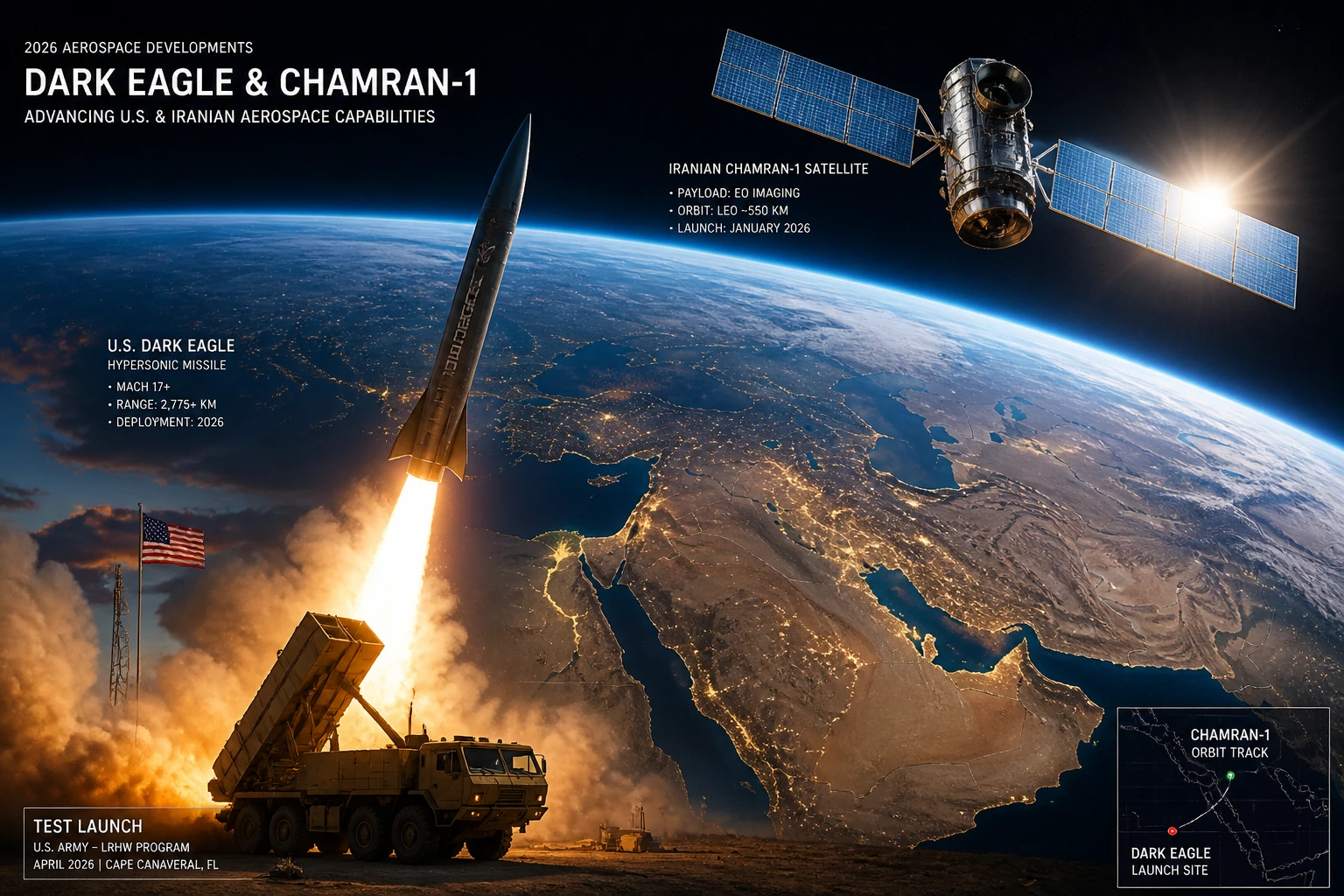
The ceasefire that paused Operation Epic Fury on April 8, 2026 did not freeze the aerospace competition between Washington and Tehran—it merely shifted its character. While diplomats shuttle between Islamabad and Moscow, both militaries are racing to field new capabilities, exploit vulnerabilities exposed during the February-March campaign, and position themselves for a conflict that senior commanders on both sides describe as probable rather than possible. Here is what has actually changed in the six weeks since the bombs stopped falling.
Dark Eagle: America’s Hypersonic Answer to Buried Missile Sites
The most significant U.S. aerospace development in the post-ceasefire period is the potential deployment of the Long-Range Hypersonic Weapon (LRHW), known as Dark Eagle, to the theater. U.S. Central Command has reportedly requested the system after Iranian forces relocated surviving missile launchers to sites deep within the country’s interior, beyond the effective reach of current U.S. land-based strike assets.
Dark Eagle represents a generational leap in strike capability. Designed to fly at speeds exceeding Mach 5—over 3,800 miles per hour—the missile follows an unpredictable trajectory through the upper atmosphere that renders existing air defense systems geometry essentially obsolete. With a range of approximately 1,725 miles (roughly 2,775 kilometers), the system could hold at risk targets anywhere in Iran from launch positions in neighboring countries or aboard naval vessels in the Arabian Sea. If deployed, it would mark the first operational hypersonic deployment by the United States in an active conflict zone, a milestone that the Pentagon has been racing toward since Russia and China fielded their own hypersonic systems.
However, the deployment is not without controversy. Some analysts have questioned the operational necessity given the extensive degradation of Iranian air defenses during Epic Fury. Retired Lieutenant General Michael Eddy told Newsmax that “Dark Eagle is not necessary in Iran” because “there is very little air defense left”. But CENTCOM planners appear to be thinking beyond the current ceasefire: Iranian engineers have been observed repairing and upgrading missile launch sites during the pause, and the relocation of mobile launchers to hardened, deeply buried facilities in central and eastern Iran presents a targeting challenge that only penetrating hypersonic weapons can reliably address.
Iran’s Regeneration Sprint: Faster Rebuilding Than Expected
The central post-war development on the Iranian side is the speed and scale of industrial reconstitution. U.S. intelligence assessments in late April acknowledged that Iran had already rebuilt a significant portion of its missile and drone production capacity—far faster than the “years to come” timeline initially projected by Gen. Dan Caine in March. A senior European official told reporters that Iran’s current limitation was “not necessarily by a lack of sites or materials, but because strikes have disrupted the organization and coordination needed for large-scale manufacturing.”
Brigadier General Majid Mousavi, commander of the IRGC Aerospace Force, confirmed in mid-April that his forces were “rebuilding their missile and drone stockpiles at a faster pace than before” during the ceasefire. Tasnim News Agency reported that Mousavi had posted video evidence of comprehensive maintenance and rebuilding operations, though the footage did not reveal specific production sites. An advisor to the IRGC commander-in-chief separately stated that “missile and drone production is continuing” and warned that newly manufactured weapons—produced in late April 2026—would be employed “if conflict resumes”.
The most visible symbol of this regeneration is the unveiling of a new generation of the Arash suicide drone. The upgraded system debuted at a pro-government rally in Tehran on April 27, with Iranian officials claiming it would “change the situation”. The new Arash builds on the combat-proven Arash-2, which struck Ben Gurion International Airport on March 21 with a 2,000-kilometer range and 260-kilogram warhead. The Arash-2 had already demonstrated that relatively inexpensive, mass-produced drones could impose disproportionate costs on advanced air defense networks, forcing the consumption of million-dollar interceptors against $20,000 threats.
The Naval Aerospace Dimension: 2,654 New Systems
On April 30, the IRGC Navy announced it had received a “large number”—specifically 2,654—of new military systems, including long-range and medium-range missiles, combat and reconnaissance drones, and electronic warfare units. The new anti-ship cruise missiles were described as having “new capabilities” with “high-explosive warheads and being untraceable,” a claim that, if substantiated, would represent a significant evolution in Iran’s ability to threaten maritime traffic in the Strait of Hormuz and beyond.
The Strait remains the conflict’s most strategically significant aerospace domain. Iran has maintained effective control over the waterway since the war began, choking off approximately 20% of global oil transit while the U.S. has imposed a counter-blockade on Iranian ports. The IRGC Navy commander’s political deputy, Hamad Akbarzadeh, warned in late April that his forces would demonstrate “new operational capabilities and advanced targeting systems” capable of engaging large naval vessels if hostilities resume.
The maritime aerospace competition is not limited to missiles and drones. The U.S. Navy has maintained a continuous presence of two aircraft carriers—the USS Gerald R. Ford and USS Carl Vinson—providing 24/7 combat air patrols alongside land-based F-35s, F-22s, and F-16CJs. These carrier-based air wings represent a mobile, survivable strike capability that can operate from international waters even if land bases in the Gulf become politically or operationally untenable.
Air Defense: The A-10 Shootdown and New Iranian Systems
The most dramatic aerospace event of the post-ceasefire period occurred on April 4, when Iranian air defenses engaged and downed at least one U.S. aircraft. Iran subsequently unveiled a new air defense system that it claimed was responsible for the engagement. A spokesperson for Iran’s Khatam al-Anbiya joint military command declared that “the enemy should know that we will achieve complete control of the sky of our country with new air defense systems built by the young scientists… of this country”.
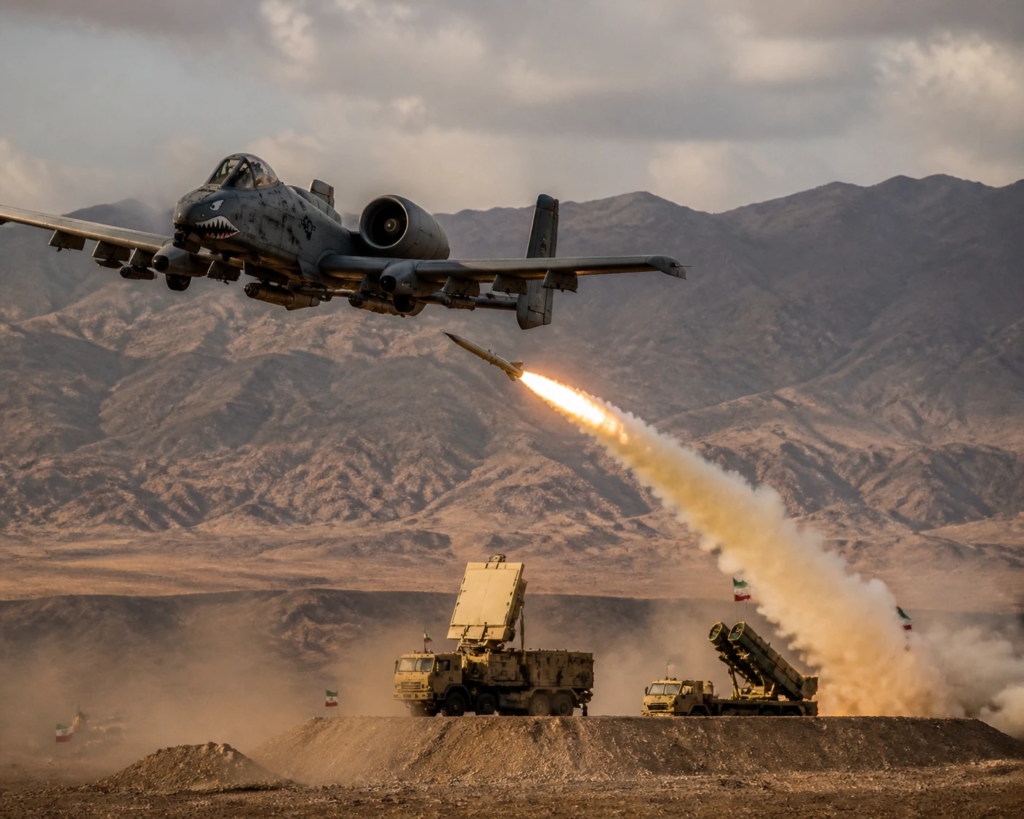
The downed aircraft was identified as an A-10 Thunderbolt II—a close air support platform operating near the Strait of Hormuz. While the A-10 is not a stealth aircraft and its loss does not indicate a fundamental shift in the air superiority balance, the incident demonstrated that Iranian air defenses remained operationally lethal even after weeks of suppression strikes. Two U.S. helicopters participating in the rescue effort were also reportedly hit by Iranian fire, though all crew members were recovered safely.
The Iranian Army’s deputy liaison, General Mohammad Hossein Dadras, subsequently announced plans to unveil additional new air defense systems and radar capabilities, including “satellite detecting radars” that would represent a significant expansion of Iran’s space surveillance capabilities.
The Space Domain: Chamran-1 Launch Despite Strikes
The most strategically significant Iranian aerospace achievement since the ceasefire is the successful launch of the Chamran-1 satellite into orbit on April 18. The solid-fuel, three-stage Qaem-100 rocket placed the 60-kilogram satellite into a 550-kilometer orbit from a mobile launcher near Shahroud. The launch represented Iran’s second successful orbital insertion using the Qaem-100, and it came despite extensive U.S. and Israeli strikes targeting Iran’s space infrastructure during Epic Fury.
The strikes had been comprehensive. The IDF announced on March 16 that it had destroyed a compound in Tehran used to develop military space programs, including anti-satellite weapons. U.S. and Israeli aircraft also targeted Iran’s main civilian satellite research center, the IRGC Aerospace Force’s space command, and facilities for rocket assembly and testing. As Jim Lamson of King’s College London assessed, “the Iranian government will likely emerge from the war with a space program that’s severely weakened”.
Yet the Chamran-1 launch proved that Iran retained operational space launch capability. The use of a mobile launcher—a technology with direct applications to road-mobile ICBMs—demonstrated resilience that fixed launch sites cannot provide. General Hossein Salami, commander of the IRGC, praised the launch as overcoming “the atmosphere of extensive and oppressive international sanctions”. The U.S. intelligence community has consistently warned that Iran’s space launch vehicle development “would shorten the timeline” for an ICBM because of shared technologies in staging, guidance, and reentry.
Diplomacy and Deterrence: The Nuclear Shadow
The aerospace competition is unfolding against a diplomatic backdrop that remains profoundly unstable. Iran submitted a 14-point proposal to the United States through Pakistani mediators in late April, focusing primarily on ending the war—reopening the Strait of Hormuz, lifting the U.S. blockade, releasing frozen assets, and removing sanctions—while explicitly deferring nuclear negotiations to a later phase. A Foreign Ministry spokesperson stated unequivocally: “There are absolutely no nuclear details in this plan”.
President Trump has so far rejected the framework, stating he was “not satisfied with what they’re offering” and characterizing Iran’s leadership as suffering from “tremendous discord”. Secretary of State Marco Rubio has insisted that any future deal must “definitively prevent” Iran from “sprinting towards a nuclear weapon”. The U.S. has also demanded that Iran not remove enriched uranium from bombed sites or resume enrichment activities during any negotiating period.
A senior Iranian military officer, Mohammad Jafar Asadi of the central command, responded by stating that “renewed conflict between Iran and the United States is likely” and that “evidence has shown that the United States is not committed to any promises or agreements”. The IRGC separately declared that the U.S. faced a choice between “an impossible military operation or a bad deal”.
The diplomatic maneuvering has been complicated by Russia’s ambiguous role. Iranian Foreign Minister Abbas Araghchi met with Vladimir Putin in Moscow on April 27, receiving what analysts describe as “unknown assurances” but no material military support. U.S. officials have indicated that Russia is providing targeting assistance and possibly some weaponry to Iran, though the exact nature of this support remains unclear. Russia faces a balancing act: supporting Iran risks angering Trump and jeopardizing the de facto U.S. accommodation of Russian interests in Ukraine, while abandoning Tehran would cede influence in the Middle East to China.
Economic Fury: Targeting the Supply Chain
Alongside the military and diplomatic dimensions, the United States has escalated its Economic Fury sanctions campaign targeting Iran’s aerospace procurement networks. On April 21, the Treasury Department sanctioned 14 individuals and entities across Iran, Türkiye, and the United Arab Emirates involved in procuring components for Iran’s UAV and ballistic missile programs. The action specifically targeted networks supplying servomotors with one-way attack UAV applications—components found in downed Shahed-136 drones.
Crucially, the April 21 action also marked the first time the United States imposed sanctions on Iran’s civilian space agency and two research institutions, based on assessments that these entities were advancing Iran’s ballistic missile program. This represents a significant expansion of the sanctions architecture, effectively declaring that all Iranian space activities—even nominally civilian ones—are considered dual-use and therefore legitimate targets for economic pressure.
The sanctions campaign aims to strangle Iran’s ability to reconstitute its aerospace industrial base by closing off the transnational procurement networks that have sustained it through decades of restrictions. However, the distributed, workshop-based manufacturing model that Iran perfected before the war means that many production nodes can operate with locally sourced or stockpiled materials, limiting the immediate impact of even well-targeted financial sanctions.
What This Tells Us About Modern Aerospace Warfare
Several clear patterns have emerged from the post-Epic Fury aerospace competition:
First, hypersonic weapons are moving from developmental curiosities to operational necessities. The potential Dark Eagle deployment signals that the Pentagon views hypersonic strike capability as essential for holding deeply buried, mobile targets at risk—precisely the kind of targets that Iran has demonstrated it can protect through hardening and dispersal.
Second, industrial reconstitution speed has become a critical metric of military power. Iran’s ability to resume missile and drone production within weeks of a devastating air campaign—faster than U.S. intelligence anticipated—underscores the limitations of strike campaigns against distributed, dual-use industrial ecosystems. Destroying factories is not the same as destroying production capacity.
Third, the cost-exchange ratio continues to favor the attacker. Iran’s $20,000 Shahed drones and new Arash variants impose costs measured in millions of dollars per interception on U.S. and allied forces. The April 30 announcement of 2,654 new naval systems—even if many are relatively simple—represents a saturation capability that no missile defense architecture can economically counter.
Fourth, space has become an inescapable dimension of the competition. Iran’s Chamran-1 launch, the U.S. strikes on Iranian space facilities, and the new U.S. sanctions targeting Iran’s civilian space agency all reflect the reality that space capabilities—for surveillance, communications, and as a pathway to ICBM development—are now central to the U.S.-Iran aerospace dynamic.
Fifth, the diplomatic and military tracks are increasingly intertwined. The ceasefire has not produced peace, only a pause in which both sides are racing to improve their positions. With the 60-day War Powers Resolution clock having expired, the legal basis for continued U.S. military operations without congressional authorization is contested. Yet neither side appears willing to make the concessions necessary for a durable settlement.
Conclusion
The aerospace competition between the United States and Iran did not end with the ceasefire of April 8, 2026. It entered a new and arguably more dangerous phase—one characterized by rapid industrial reconstitution, the deployment of game-changing hypersonic capabilities, continued contestation of the space domain, and economic warfare targeting the supply chains that sustain military production. As Brigadier General Mousavi’s forces rebuild stockpiles faster than before and CENTCOM prepares to field Dark Eagle, the question is not whether the aerospace war will resume, but when—and which side will have improved its position most during the interregnum.
