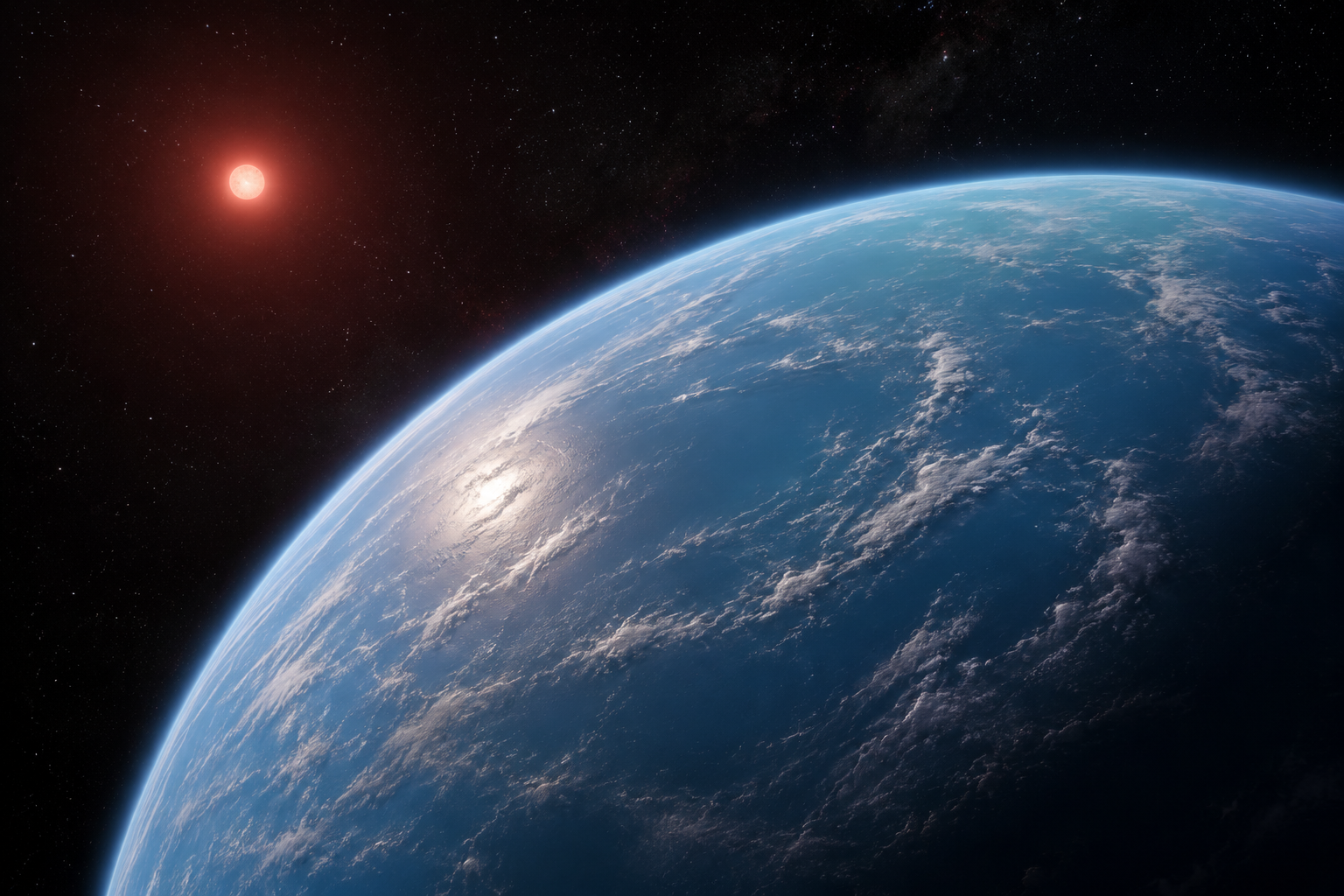
The discovery was confirmed by a team of international researchers after a series of observations using multiple instruments on the James Webb Space Telescope. The initial discovery was made by the Transiting Exoplanet Survey Satellite (TESS), which detected a transit—a slight dimming of the star as the planet passed in front of it.
Further investigation by James Webb allowed scientists to confirm the planet’s existence and gather data on its composition and atmospheric makeup. Using a technique called transmission spectroscopy, the telescope analyzed the light that passes through the planet’s atmosphere, revealing the presence of what could be water vapor and clouds, along with an unexpected Earth-like mix of gases.
This discovery marks a significant milestone in the search for habitable worlds. As noted by Dr. Olivia Chen of the Space Telescope Science Institute, “The discovery of LHS 1140 b is not just another exoplanet. It’s a new hope.”
The LHS 1140 b system: a unique exoplanetary home
LHS 1140 b orbits a small red dwarf star, LHS 1140, which is located about 48 light-years from Earth in the constellation Cetus. The system is significantly different from our own, offering a unique backdrop for this groundbreaking discovery.
Unlike our Sun, LHS 1140 is a red dwarf, the most common type of star in the galaxy. This characteristic is crucial to the planet’s potential habitability, as the star’s smaller and cooler nature means its habitable zone—the region where temperatures could allow liquid water to exist—is much closer than in our own solar system.
Although red dwarfs are known to be incredibly active, LHS 1140 appears to be a quieter specimen, reducing the risk that the planet’s atmosphere was stripped away by violent stellar flares early in its history. This stability makes LHS 1140 b an even more compelling subject for future study.
How Earth-like is the LHS 1140 b exoplanet?
The composition and structure of LHS 1140 b make it a strong candidate for a planet that could support life. The planet is a super-Earth, with a mass about 5.6 times that of our planet and a radius about 1.4 times greater, giving it a density similar to Earth’s. This suggests a composition of rock and iron, not too dissimilar from our own.
What makes LHS 1140 b truly exciting is its atmosphere. The spectroscopic data hints at a nitrogen-rich atmosphere, just like Earth, with other trace gases that could be consistent with biological processes. This is vastly different from the thick, toxic atmospheres of Venus or Titan, bringing us one step closer to finding a true Earth analog.
The planet orbits within its star’s habitable zone, receiving a similar amount of energy from its star as Earth receives from the Sun. Depending on the composition of its atmosphere, the surface temperature could allow liquid water to exist in vast oceans, dramatically increasing the probability of life.
The most thrilling exoplanet discovery since Proxima b
The discovery of LHS 1140 b is being celebrated as one of the most important events in modern astronomy. While many exoplanets have been discovered, the detailed atmospheric information provided by the James Webb Space Telescope sets this discovery apart, offering us our clearest look at a world that could be genuinely Earth-like.
This discovery eclipses the enthusiasm once reserved for Proxima b and TRAPPIST-1e, as the data is far more robust and less ambiguous. The ability to detect what appears to be water vapor and an Earth-like atmosphere is a testament to the power of advanced space telescopes. LHS 1140 b is a game-changer, providing the first real evidence that planets orbiting other stars can have atmospheres not only similar to Earth’s but potentially composed of similar ingredients.
A new chapter in the search for life beyond Earth
The discovery of LHS 1140 b represents a giant leap in humanity’s quest to find life beyond our own world. It moves the question from “are we alone?” to “how soon will we know?”. The upcoming years will be dedicated to further refining our understanding of this fascinating world.
Future missions involving the James Webb Space Telescope will continue to study the planet, hoping to identify biosignatures—specific chemical markers in the atmosphere that could be produced by living organisms. Additionally, the next generation of ground-based telescopes will attempt to map its surface and search for evidence of seasonal changes.
LHS 1140 b is a testament to human curiosity. It is a world 48 light-years away that is inspiring us to look up, to build better tools, and to never stop asking the biggest questions of all.
Stay tuned to SpaceNerve for the latest updates on this developing story and for more in-depth analysis of the most exciting discoveries in space.
